Fabrication Materials and Techniques
Welding and Structural Metalwork
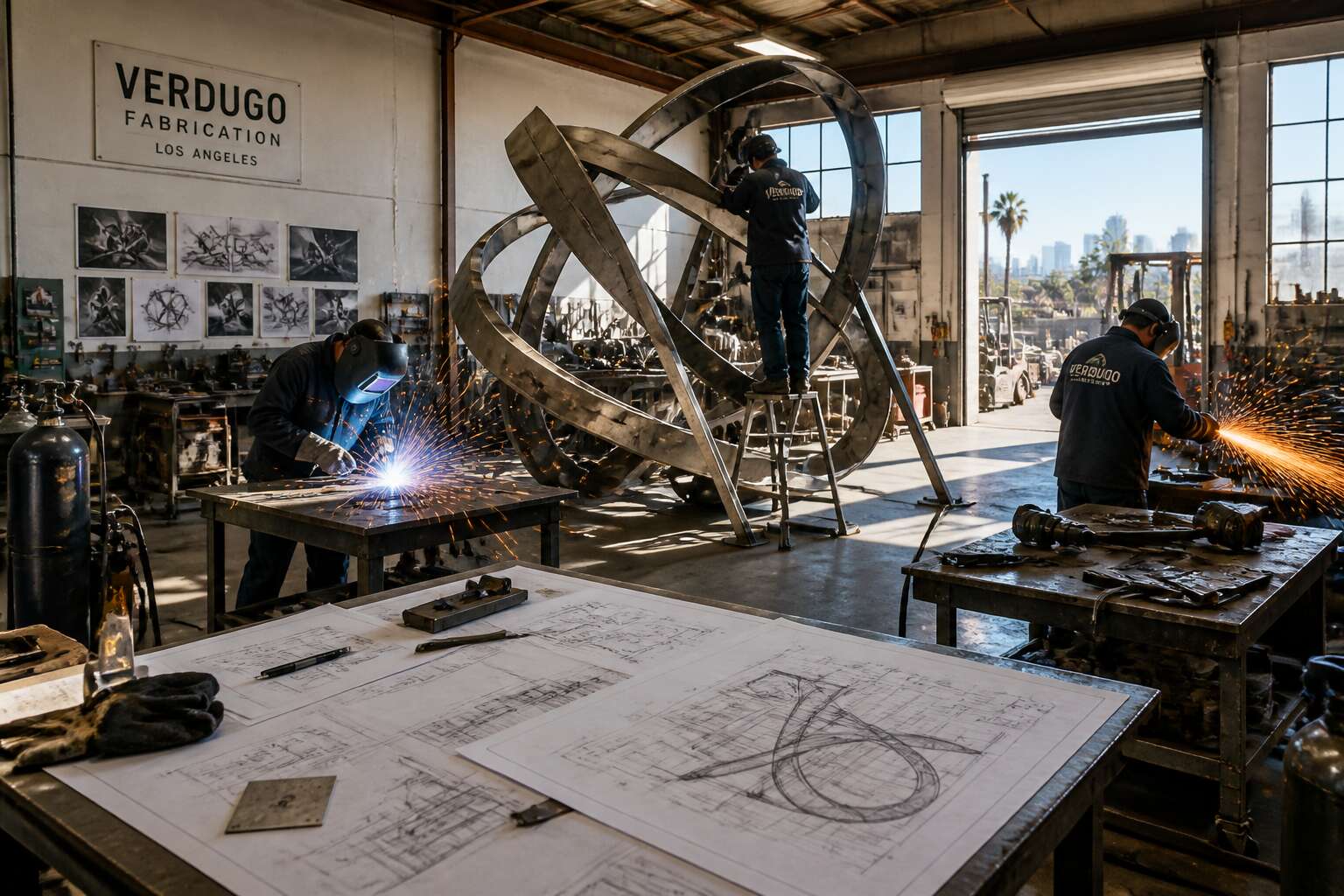
A sculpture might win the design award, but its skeleton keeps it standing. In the sprawling sheds of art fabrication los angeles, the choice of metal is tactical. Structural steel offers brute strength, while aluminum brings light-footedness. Corten steel provides a rusted patina that ages artistically.
Welding varies as much as the metals. TIG welding delivers precise beads for exhibition finishes, whereas MIG welding offers speed for monumental pieces. Stick welding still has its place outdoors. The common materials break down like this:
- Mild steel: cheap, versatile, and forgiving.
- Stainless steel: resists weather but demands a skilled hand.
- Aluminum: lightweight but prone to warping.
- Corten steel: develops a protective rust layer that dyes your hands.
The real test comes when the crane lets go. A poorly planned weld can shear off, sending a million rand investment crashing down. Structural tolerances are checked and rechecked. This obsessive work builds the reputation of art fabrication los angeles. Nobody sees the weld, but everybody notices when it fails.
Plastics, Composites, and Resin Fabrication
Acrylic and fibreglass rarely get a mention, yet they shape the look of art fabrication los angeles. Plastics offer transparency, colour, and flexibility. Composites such as carbon fibre provide strength without weight. Resin casting creates forms that machining cannot produce.
- Acrylic, or Perspex, cuts cleanly and polishes well.
- Polyurethane resin cures fast, but it reacts to humidity.
- Fibreglass layup requires patience to avoid air bubbles.
The real issue is air. A vacuum chamber removes it, but some fabricators prefer tapping the mould. The material choice shifts the design. A glowing resin panel suits a tech aesthetic, while rough fibreglass suits an industrial one. Each demands respect for cure times.
Surface Finishing: Paint, Powder Coat, and Patina
Surface finishing decides how the public experiences a sculpture before they touch it. In art fabrication los angeles, paint remains the most direct way to control color and texture. A skilled finisher can layer pigmented coatings so they shift with the afternoon sun. Powder coat offers durability for outdoor pieces, resisting chips and fading far longer than standard enamel. Patina, applied through chemicals and heat, gives metal a living surface that evolves slowly over months.
The process demands attention to variables that most viewers never consider:
– Ambient temperature during application, which changes flow and adhesion.
– Surface preparation, from sandblasting to solvent wiping, which determines longevity.
– Cure time relative to the humidity of the day, which can ruin a flawless coat.
Each method changes the outcome. Powder coat requires a perfectly smooth substrate. Paint allows for subtle touch ups later. Patina rewards patience, since the reaction never fully stops. The finishing bay becomes a quiet laboratory where chemistry meets aesthetics, and every piece carries the signature of its climate.
Precision Machining and CNC Services
Precision machining gives sculptors the ability to repeat a form exactly, down to fractions of a millimeter. In art fabrication los angeles, CNC routers and lathes turn digital models into physical components without the trembling hand of human error. A five axis mill can carve complex curves from aluminum or stainless steel, while water jet cutting handles sheet metal with a cold, clean edge.
Materials matter here. Brass offers warmth, titanium offers strength, and tooling plastics offer a lightweight option for temporary installations. The choice affects both the fabrication process and the final weight of the piece.
- CNC milling for intricate three dimensional shapes
- Water jet cutting for flat patterns with zero heat affected zone
- Precision turning for cylindrical components
Each run is verified with calipers and coordinate measuring machines, so the finished sculpture matches the artist’s vision, not an approximation of it.
Glass and Mixed-Media Fabrication
Glass does not bend. It shatters, making the practice of art fabrication los angeles exacting when mixed media is involved. Kiln casting creates volumetric forms, while cold working involves cutting and grinding. When paired with steel or concrete, the joint demands precision. The coefficient of expansion dictates how these materials coexist.
Bonding methods vary:
- Structural silicone offers a flexible, invisible bond.
- Mechanical fixings allow for disassembly but require meticulous drilling.
- Lamination layers glass with film for safety.
I have seen projects fail because the fabricator treated glass like a rigid metal plate. The material demands a distinct approach, one that respects its thermal behavior instead of merely anchoring it in place.
How to Choose a Fabrication Partner in Los Angeles
Evaluating Portfolio and Relevant Experience
Choosing a fabricator in Los Angeles is a delicate social exercise. The portfolio reveals taste, sure, but also patience and honesty. Ask to see failed prototypes alongside finished works. That is where the real character emerges!
When evaluating relevant experience, consider these details:
- Years of direct work with your chosen materials
- Documentation of problem solving during fabrication
- References from artists with similar production scales
I have seen art fabrication los angeles projects that looked immaculate on paper but collapsed under time pressure. The best partner will answer questions about shop floor capacity without hesitation. That confidence, offered plainly, is worth more than any glossy presentation folder.
Assessing Equipment, Facility, and Safety Standards
Walk into a fabrication shop and the first thing you notice is the floor. Is it swept? Are cables managed or trailing across walkways? The equipment reveals priorities. A proper art fabrication los angeles studio invests in calibrated machinery and dust collection systems. You want to see maintenance logs. Fresh paint can hide a lot. In my experience, the best shops have a dedicated area for material storage and a clear separation between welding bays and finishing rooms.
Safety standards reveal how a team treats its people and your project. Look for ventilation, fire suppression, and eye wash stations. These details matter. A quick checklist can help you assess a facility:
- Are emergency exits marked and accessible?
- Are compressed gas cylinders chained?
- Is there a written safety protocol?
The right partner will walk you through their shop floor. Hesitation suggests gaps. And in art fabrication los angeles, a small oversight can compromise months of work.
Budget, Timelines, and Deposit Structures
A veteran fabricator once told me, “The deposit protects my time and my materials.” That principle informs many timeline and budget discussions in art fabrication los angeles. A credible shop explains its deposit structure in writing. Expect a deposit to secure materials, then milestone payments tied to fabrication progress. Timelines should include buffer days for finishing and delivery. Ask how the shop handles change orders and who approves them.
Review these points before signing:
- The required notice for project scope changes
- Whether the deposit is refundable if the start date slips
- The penalty for missed delivery dates, if any
The budget is a working document. It changes with each material choice, but the timeline should remain predictable. That clarity protects both sides.
Communication and Project Management Approaches
Choosing a fabrication partner in Los Angeles often comes down to how they handle the moments between the sparks flying. A shop that returns calls within a day treats your project like it matters. One that goes silent for a week is telling you something, and it is not good news.
Project management approaches vary widely across art fabrication los angeles. Some shops use formal software with daily updates. Others prefer a quick text and a photo. Both can work, but only if you understand the system before you sign.
- Who is your main point of contact?
- How often do they report progress?
- What happens when a deadline shifts?
Ask these questions early. The answers reveal more than any portfolio ever will.
From Concept to Completion: The Fabrication Workflow
Concept Development and Detailed Drawing Preparation
Every artwork begins with a conversation between client and fabricator. In the realm of art fabrication los angeles, that conversation yields a concept sketch, then a detailed drawing. The process demands precision, not guesswork.
We refine scale, materials, load points, and assembly methods. We check every dimension against the physical site. A single corrected number can save a week on the shop floor.
Consider these early phases:
- Initial ideation and feasibility review
- Material and joinery decisions
- Structural load calculations
- Final engineering drawings
Once approved, the drawing becomes the blueprint for every cut and weld. Accuracy here prevents costly rework later.
Prototyping and Material Testing Processes
In art fabrication los angeles, we have a rule: break things on purpose, on our schedule, so they don’t break on yours. That is why we build prototypes. We make samples, poke them, stress them, and expose them to the elements. The workshop is a laboratory for failure.
Here is the ritual:
- Scale models for form review
- Destructive testing on coupon samples
- Finish swatches under site lighting
Every test produces data, not opinions. The process is tedious, expensive, and utterly necessary. Skip it, and the artwork will tell you. Usually at the worst possible moment.
Material Sourcing, Procurement, and Lead Times
In art fabrication los angeles, the workflow begins before a torch is lit. It starts with a call to a steel supplier in Vernon, a quarry in Northern California, or a plastics distributor in Gardena. Every material has distinct properties, and every supplier has a schedule. We plan for the gap between order and arrival.
Lead times shape the project’s timeline. Custom alloys may take eight weeks. Cast glass can take twelve. Even standard stock can vanish overnight. In art fabrication los angeles, teams lock in orders early and keep a buffer of raw stock. Procurement is a conversation, not a form.
- Mill certifications verify steel composition.
- Patina chemicals may require hazmat shipping.
- Stone blocks are often cut to order overseas.
We track every purchase order with precision. When materials arrive on time, the workflow proceeds smoothly. When they do not, we adjust.
Fabrication, Assembly, and Quality Control Checkpoints
In art fabrication los angeles, the shop floor reveals what drawings cannot. Assembly starts with dry fitting each component before any permanent connection. Tolerances are tested here. Misalignments surface here. The physical build demands constant attention to detail.
Quality control checkpoints are placed at defined intervals, never at the end. Dimensional verification follows each major subassembly. Surface condition is checked before any finish is applied. Final fit and function are confirmed before crating for delivery.
- Verify dimensions against the latest drawing revisions
- Inspect joint alignment and mechanical fasteners
- Confirm hardware torque and component fit
Every checkpoint produces a written record. A failed piece returns to the bench with documented notes attached. The workflow in art fabrication los angeles depends on this discipline to deliver work that meets the original intent.
Surface Finishing and Detailing Techniques
Surface finishing rarely begins on the bench. It starts during the concept phase, when edge profiles and texture placement are mapped onto the drawings. Those early decisions determine what happens later.
The finishing workflow in art fabrication los angeles follows a deliberate rhythm. Each step prepares the surface for the next. Sanding removes tool marks. Primers seal the substrate. Final coats are inspected under controlled lighting. I have seen projects where a single overlooked seam required weeks of rework.
Key detailing techniques include:
- Edge definition and radius control
- Masking for multi-tone surfaces
- Texture application for tactile contrast
- Protective sealing for long-term durability
Every pass gets documented. A small inconsistency in the first layer becomes a visible flaw in the last. That is why the workflow treats finishing as part of the build, not an afterthought.
Transportation, Rigging, and On-Site Installation Challenges
The art does not finish at the warehouse door. A finished piece becomes a fragile, oversized problem the moment it must move. Art fabrication los angeles studios routinely build works that exceed standard freight dimensions, so transportation becomes a discipline of permits, escort vehicles, and exacting schedules. One missed window at a loading dock can unravel an entire installation timeline.
Rigging demands the same precision as welding. A 2,000 pound sculpture swinging above a polished concrete floor leaves no room for guesswork. Crews map the load path, verify anchor points, and rehearse the lift sequence before the crane arrives. Site conditions rarely cooperate. Narrow stairwells, low ceiling clearances, and delicate finishes all threaten the final placement.
- Coordination with building engineers for floor load ratings
- Use of air skates for tight interior turns
- Temporary supports for cantilevered installations
The best teams treat the installation site as an extension of the fabrication floor. They bring their own rigging mats, protective films, and decision-making protocols.
Fabrication for Public Art and Commercial Spaces
Public Art Commissions, RFQs, and Permitting Considerations
Public art is a different beast. Unlike gallery work, it lives in the open, subject to weather, vandals, and municipal code. The commissioning process usually starts with an RFQ, where artists submit qualifications rather than finished designs. Selection panels then narrow the field. Once chosen, the real fun begins: permitting. Cities have rules about structural integrity, electrical access, and even sightlines for traffic. A reputable art fabrication los angeles studio will navigate these requirements early. They coordinate with engineers and city officials before welding begins. This prevents expensive rework.
Typically, the process involves:
- Public art commission approvals
- Structural engineering sign-offs
- Right-of-way or easement permits
- Final site inspection
Each jurisdiction differs, so local knowledge matters.
Gallery and Museum Installation Requirements
Public art fabrication demands a different mindset entirely. A sculpture meant for a plaza must endure wind loads, seismic shifts, and constant foot traffic. Art fabrication los angeles studios approach these projects with engineering at the forefront. They produce crates for museum loans, design mounting systems for gallery walls, and coordinate with rigging teams for heavy installations. The requirements vary by venue. Museums often demand climate-controlled cases and archival materials. Commercial spaces may need structural anchors that meet fire codes. Each surface, joint, and fastener becomes a specification. Consider the logistics:
- Art handling insurance certificates
- Condition reporting before and after transit
- Site-specific load calculations
These details separate successful installations from costly failures. A studio with local knowledge knows how to satisfy both the artist and the institution.
Architectural Integration and Corporate Installations
A corporate plaza presents a different kind of challenge. The sculpture must survive constant sun, rain, and the occasional delivery truck. Art fabrication los angeles teams often design these pieces with sacrificial anodes and drainable joints to prevent corrosion. They also plan for how the work will be cleaned and serviced over decades. The most successful installations feel like they grew from the pavement rather than being dropped onto it. That requires reading the building’s massing, material palette, and pedestrian flow. For interiors, the constraints shift. A lobby installation may need to support hanging planters or integrate with digital displays. Fire egress routes and cleaning equipment paths can dictate the final geometry.
For one recent project, the engineering team had to account for:
- Wind tunnel data for the corner plaza
- Helicopter lift limitations for the main structure
- Thermal expansion across a glass curtain wall
Art fabrication los angeles studios bring this site-specific knowledge to every proposal. Their experience with urban permitting and structural reviews makes them a better partner for architects who want a signature piece without the guesswork.
Emerging Trends in Art Fabrication
Sustainable Materials and Eco-Friendly Processes
A shift is underway in Los Angeles workshops. The art fabrication los angeles scene now prioritizes materials with a lighter footprint. Recycled aluminum and reclaimed steel appear alongside bio-based composites made from hemp or flax.
Eco-friendly processes are equally critical. Water-based adhesives replace solvent-heavy alternatives. Dust extraction systems capture fine particles for reuse. Some studios even power kilns with solar arrays.
- Closed-loop water filtration for wet cutting
- Biodegradable mold release agents
- Powder coat overspray recycling
This is not a passing trend. It is a response to client demands and regulatory pressure. My own projects now specify materials that can be separated and recycled at end of life. The result is work that feels contemporary without ignoring its environmental cost.
Digital Fabrication: CNC Milling, Water Jet, and Laser Cutting
Los Angeles studios are entering a curious phase: the machine as collaborator. CNC milling, water jet cutting, and laser cutting once served as rapid prototyping tools. Now they shape final works in metal, stone, and composite panels. Water jet cutting slices thick stainless steel with abrasive suspended in high pressure water, leaving no heat affected zone. Laser cutters deliver detail down to fractions of a millimeter. These techniques are changing how art fabrication los angeles teams approach scale and repetition, allowing artists to iterate quickly without sacrificing precision.
An artist hands a finished three dimensional file to a fabricator, and minutes later a robotic arm begins carving. The hand returns during finishing. Increasingly, art fabrication los angeles studios invest in hybrid cells that combine robotic milling with manual polishing, closing the gap between digital accuracy and tactile expression.
3D Printing and Advanced Prototyping
Additive tools realign how artists approach production. In art fabrication los angeles, 3D printing now moves beyond the maquette. Large-format machines build furniture and wall panels from carbon fiber reinforced nylon, while resin printers capture textures impossible to mill. Advanced prototyping lets a team test water flow through a sculpture or check structural load before committing to a mold. This changes the budget conversation. Clients see a tangible object in hours, not weeks.
Common advances shaping this trend:
- Multi-material printing for rigid and flexible sections in one pass
- Direct printing of sand molds for metal casting
The hand still enters later for assembly and finish, but the early risk disappears. For artists and architects, this means more iterations, better material data, and fewer surprises when the piece arrives on site. Trust in art fabrication los angeles grows when the prototype matches the final form.
Interactive, Kinetic, and Light-Based Installations
A kinetic sculpture is never finished at the fabrication shop. It finishes when a visitor steps close and the work tilts, hums, or changes color in response. Art fabrication los angeles studios now build interactive pieces with servo motors, magnetic drives, and custom gearing that react to movement in the room.
Light based installations push this further. Projection mapping and fiber optics let artists alter architecture without touching it. But interactivity demands rigorous testing. Sensors fail, LEDs drift in color temperature, and a gallery floor vibrates in ways no drawing predicts.
- Sealed electronics for humidity and dust
- Redundant power systems for sustained viewing hours
Art fabrication los angeles handles that uncertainty so the artist owns the surprise, not the failure.
Collaborative Artist-Fabricator Studio Models
The collaborative studio model has changed how artists and workshops relate. Artists embed themselves in the production process instead of handing over a spec sheet. The relationship becomes shared experimentation, not a vendor transaction.
Regular touchpoints anchor the work:
- Weekly material testing and adjustment sessions
- Joint sourcing of specialty components
- Shared documentation for maintenance and future editions
Art fabrication los angeles studios that embrace this structure produce work grounded in dialogue. The friction between maker and artist becomes part of the object’s history, not a hurdle to overcome.


0 Comments