Core Principles of Structural Metal Production
Engineering Blueprints and Design Coordination
The blueprint is the backbone of the entire steel building structure fabrication workflow. A minor error in a connection detail can cascade into costly on-site corrections, a reality every South African engineer knows all too well. This phase demands more than just drawing lines; it requires translating architectural intent into a language the workshop understands completely.
Coordination between the engineering team and the fabrication floor is where precision is won or lost. We focus heavily on clash detection and load path verification before any cutting begins. The design must speak to the specific capabilities of the machinery, from CNC drilling to the welding bays, ensuring every beam and column is ready for assembly without guesswork. The dialogue between the draughtsman and the project manager is constant, refining the process before a single plate is cut.
– Reviewing weld symbols and bolt specifications for site conditions.
– Aligning the erection sequence with the production schedule.
– Validating material grades and mill certificates against the specification.
Effective coordination also means managing tolerances on paper, so they hold up in reality. By integrating the detailing with the practical constraints of the shop, we reduce waste and accelerate turnaround times. This discipline in the design stage directly improves the integrity and efficiency of steel building structure fabrication, ensuring the final asset is both safe and cost-effective.
Material Selection Criteria
A steel building structure fabrication project in South Africa lives or dies by its material selection. The wrong grade, chosen to save a few rand per ton, can fail silently under load or corrode prematurely near the coast. Cheap steel invites expensive consequences.
We weigh three properties before anything else: yield strength, weldability, and corrosion resistance. Each one changes how the workshop cuts, drills, and assembles the members. Local conditions dictate the choice, and that is why we read the site before we read the spec. For most industrial projects, we specify:
- S355JR for balanced strength and formability under dynamic loads
- S275JR where dead weight matters less than initial cost
- Hot-dip galvanized sections for aggressive coastal exposure
Certification carries as much weight as chemistry. Without a valid mill certificate, the steel building structure fabrication process loses its traceability and site acceptance stalls. Every delivery gets matched against the approved specification before cutting begins!
Cutting and Shaping Techniques
Cutting and shaping demand the same discipline as drafting. A beam that arrives a millimetre out of square will haunt the entire assembly. For steel building structure fabrication, the workshop is where the design becomes physical, and the margin for error shrinks at every pass.
We use CNC plasma cutters for plate work and cold saws for clean, square ends on structural sections. For heavy profiles, a band saw with swivel capability handles mitred cuts without introducing heat distortion. Each method leaves a different edge condition, and that dictates how the welder preps the joint.
- CNC plasma for complex gusset plates
- Cold saw for tight-tolerance beam lengths
- Band saw for angled cuts on thick sections
Shaping follows cutting. We roll, bend, or press members only after confirming the material’s yield strength, because springback varies between grades. The team measures every profile before it leaves the bay, and that final check is what makes steel building structure fabrication reliable on site.
Assembly and Welding Methods
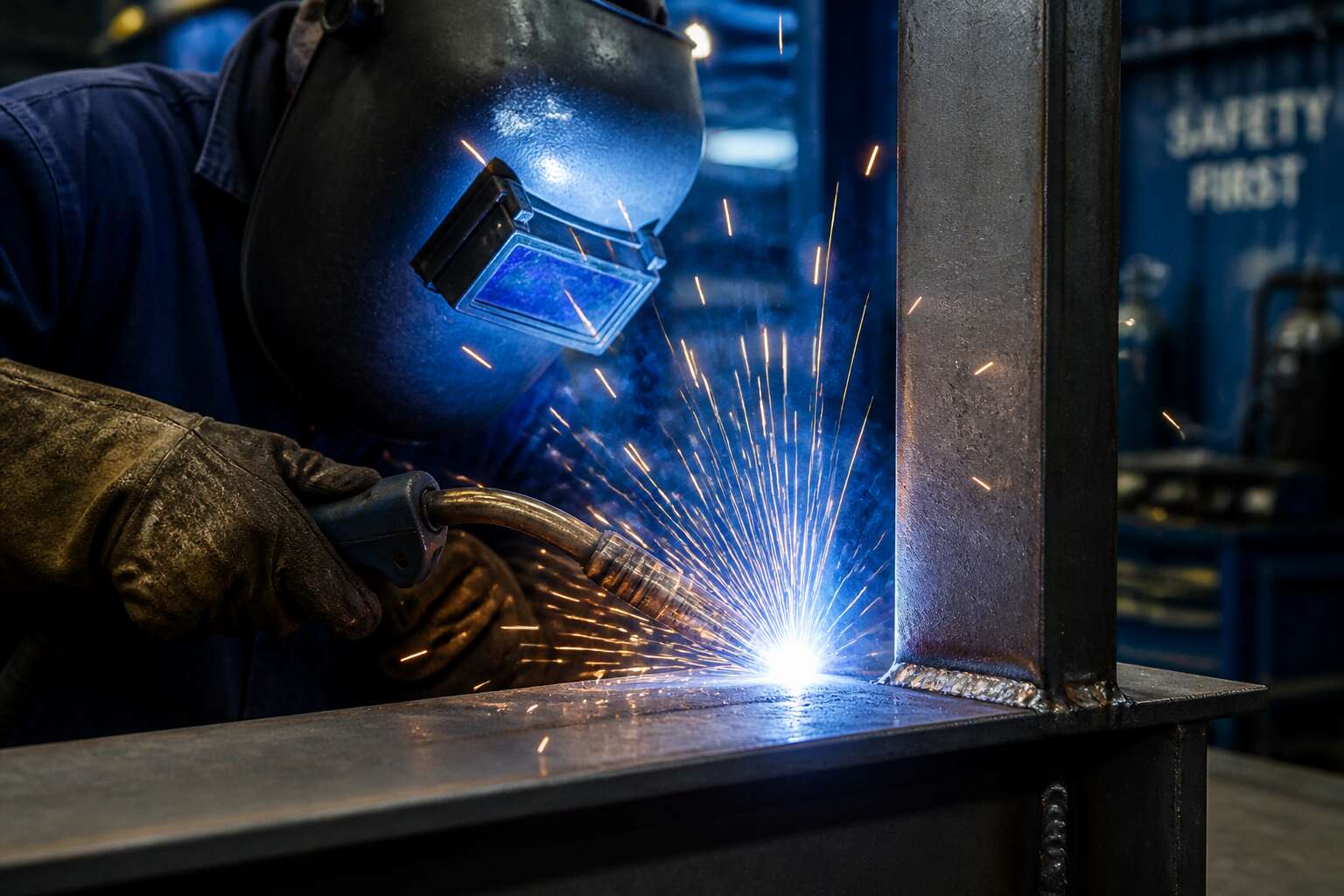
Somewhere in the final assembly bay, the measured confidence of the workshop floor gives way to controlled chaos. Fit-up is the first true test of character for any steel building structure fabrication. The fitter aligns the members, tack welds them, and checks the squareness with a level of suspicion usually reserved for a dubious bargain. A poor fit here forces the welder to compensate, which is never a good look on a permanent structural connection.
The welding methods themselves are a study in applied pressure, but also in restraint. Robotic MIG units handle long, repetitive seams with a tireless hand, while skilled operators manage the critical field connections where the human eye still outperforms the machine. For high-stress nodes, flux-cored arc welding offers deep penetration and a forgiving nature on site.
A sub-assembly often includes:
– Column base plates with stiffeners
– Rafter splices for transport
– Crane girders with intermediate stiffeners
Each weld sequence receives its own thought. Skip welding prevents distortion, and peening relieves stress, but only when the material thickness demands it. The final inspection, from visual checks to ultrasonic testing, confirms the strength of every joint. That discipline is what carries the steel building structure fabrication from a tidy drawing to a sound, weathertight frame that stands straight on the veld.
Raw Materials and Pre-Fabrication Steps
Sourcing High-Grade Steel Alloys
South Africa produces roughly 6.3 million tonnes of crude steel each year, yet sourcing high-grade alloys for steel building structure fabrication remains a demanding exercise. The chemical composition, the mill certificate, the heat number. I have watched procurement teams chase these details with admirable stubbornness. Each element determines how the final structure will behave under load.
Pre-fabrication steps begin before any cutting or shaping. The delivered steel must be quarantined and inspected for lamination, surface scabs, and rust pitting. Yield strength tests confirm the batch matches the specification. A reputable fabricator verifies every delivery, regardless of how long the supplier has been trusted.
- Confirm the heat number and mill certificate against the purchase order.
- Inspect for surface defects and mechanical damage during transit.
- Store the alloy on bearers, off the ground, to prevent contamination.
Only then is the material released to the workshop floor!
Surface Treatment and Rust Prevention
Rust costs the global economy billions every year, yet its true toll is measured in compromised structures and shortened lifespans. In steel building structure fabrication, surface treatment is not a cosmetic afterthought; it is the first line of defence against corrosion. The process begins the moment the plate leaves the mill, with an aggressive cleaning regime that determines how the final structure will endure the elements.
Abrasive blasting is the standard first step, removing mill scale and existing corrosion to achieve a specific surface profile. This profile creates a mechanical key for the protective coating. For industrial projects in aggressive coastal environments, the specification may demand a near-white metal finish. The inspection is rigorous:
– Check the surface profile depth against the specification.
– Verify the blast media is free from oils and contaminants.
– Confirm the surface is dust-free before priming.
Following blasting, a primer is applied swiftly to prevent flash rusting. This coating acts as a sacrificial layer, protecting the steel until the final paint system is applied on site. The choice of primer, whether zinc-rich or epoxy, depends on the structural role and the atmospheric conditions it will face. Each pass of the spray gun is a calculated decision. This disciplined process ensures the steel’s integrity, making the entire investment in steel building structure fabrication last for decades.
Plate and Section Straightening
Steel arrives from the mill with internal stresses and residual deformation. In steel building structure fabrication, the first task is to force the material back to true geometry. Plate and section straightening is a precision process that addresses the unavoidable warpage from hot rolling and cooling.
A roller leveler applies repeated bending to flatten plate. For structural sections, a straightening press works on flanges and webs. The goal is to achieve tolerances that allow welding and assembly to proceed without distortion. We check each piece with a straight edge and feeler gauge. If the deviation exceeds the specification, the process repeats.
The sequence matters:
- Inspect the incoming material for visible bends and twists.
- Select the correct machine based on section size and grade.
- Run the material through the leveler or press in small increments.
- Verify straightness after each pass.
Layout and Marking for Precision
In South Africa, a single millimetre of error on a steel column multiplies across a frame. That is why layout and marking demand more than a chalk line. Before any steel building structure fabrication begins, we verify the raw material against mill certificates. Chemistry, yield strength, and section dimensions must match the specification. Only then do we move to the layout table.
We use the following sequence for every member:
1. Set reference points from the datum line on the shop drawings.
2. Transfer centre lines and bolt hole positions using a scribe and steel rule.
3. Punch each intersection to create a permanent indentation.
Marking must stay visible after cutting and fit-up. We prefer low-stress punches over centre punches to avoid denting the surface. Our layout crew works directly from the approved model, not from memory. This step separates precision from guesswork in steel building structure fabrication, and it keeps every subsequent weld and bolt aligned.
CNC Programming for Automated Cutting
Once the raw steel passes inspection, it heads to the CNC plasma table. But that machine doesn’t think for itself. Someone must translate the approved 3D model into a language of torches and kerf. This is where CNC programming becomes the quiet backbone of steel building structure fabrication. We extract DXF files, nest profiles like puzzle pieces, and assign cut paths to minimise waste. The programmer also factors in material thickness, thermal distortion, and the occasional stubborn inclusion. Every command matters.
We follow this sequence for every automated cut:
- Import the shop drawing geometry directly from the model.
- Set kerf compensation based on the cutting method.
- Simulate the torch path to spot collisions or sharp angles.
- Upload the final G-code to the cutting controller.
A rushed programme produces scrap. A careful one delivers edges that need minimal grinding. We treat CNC programming as a pre-flight check, not an afterthought. Good programming saves hours downstream, which is why we never skip this step in steel building structure fabrication.
Advanced Fabrication Technologies
Beam Line and Coping Operations
A single misplaced cope can stall an entire erection crew. The beam line and coping station exist to prevent that. Sawed members arrive at the station and have web and flange sections removed at the ends, creating profiles that nest neatly against columns or girts.
Modern beam lines link sawing, drilling, coping, and marking in one flow, which keeps handling errors low and tolerances predictable. This is central to steel building structure fabrication, because dimensional drift on long spans becomes expensive when a connection does not line up.
- Web cutouts for seat angles and stiffeners
- Flange bevels for full penetration welds
- Bolt holes drilled after the cope, so positions stay true
Each step references the same 3D model, meaning a fabricator can cut confidently and assemble without trial fitting every connection on the floor.
Robotic Welding Systems
Robotic welding systems have changed how South African fabricators handle repetitive joints. A single robot cell can produce consistent fillet welds across hundreds of identical members, which matters in steel building structure fabrication because a subtle variation can delay the entire frame. I have observed shops cut rework rates in half with this technology.
The key lies in adaptive control. Sensors read the joint gap and adjust voltage on the fly, so even slightly warped sections receive a sound weld. Some systems also log every pass, giving engineers traceable data for quality audits.
- Robots work without fatigue, maintaining torch angle for each weld.
- They flag porosity or spatter before the part advances.
- They free skilled welders for complex nodes and repairs.
This shift moves steel building structure fabrication from manual consistency to systematic reliability. For high volumes, the upfront investment returns quickly.
Drilling and Punching Equipment
Watching a drill bit chew through a 25mm flange explains why hole making deserves respect. The drilling and punching equipment in modern South African shops handles thousands of apertures per shift, each positioned with minimal deviation. This is not glamorous work. Still, a structure with misplaced holes may never assemble.
In steel building structure fabrication, these machines do the heavy lifting. CNC drilling lines orient the member once, then punch every hole without rechecking. Punching presses handle thinner material with incredible speed. Each process leaves different edge qualities, so choosing between them depends on connection type and plate grade.
- Drilling suits thicker sections where punched holes distort the steel.
- Punching excels for repetitive, high volume work on lighter members.
- Combined stations reduce handling time and maintain accuracy.
Blast Cleaning and Coating Systems
Most corrosion begins where the eye stops looking. In South African shops, blast cleaning removes mill scale and rust with steel shot or grit, leaving a uniform surface profile that topcoats can actually bite into. Modern blast rooms recycle abrasive and manage dust through cartridge filtration, which keeps the operation efficient and the air clean.
Coating systems then follow a strict sequence. Primer, intermediate, and top coats are applied in controlled booths where humidity and temperature are monitored. Dry film thickness gets checked with magnetic gauges at every stage. The margin for error is small. Too thin, and the steel building structure fabrication may fail prematurely. Too thick, and solvents become trapped under the film.
- Blast cleaning creates the anchor pattern needed for adhesion.
- Coating thickness is verified before each new layer.
- Environmental data is logged for warranty traceability.
Some operations rely on robotic sprayers for consistency. Others depend on experienced operators who adjust their technique by feel. Both approaches can deliver lasting protection when the system is respected.
Handling and Rigging Heavy Components
Heavy components demand respect. In steel building structure fabrication, a 30 ton girder swinging overhead is routine. Advanced fabrication technologies now include hydraulic gantries and load cells that measure every lift.
Before any move, riggers verify sling angles and centre of gravity. The margin for error is centimetres. We rely on these systems daily!
- Spreaders keep loads level.
- Remote controls eliminate guesswork.
- Load monitoring prevents overstress.
Modern shops pair these tools with laser guided positioning. The result is faster, safer assembly. No heroics, just precision.
Tolerance Verification with Laser Scanning
Laser scanning has changed how we verify tolerances in steel building structure fabrication. A single sweep captures millions of data points, mapping each flange and web against the digital model. We compare actual dimensions to design tolerances in real time. Deviations are caught before they compound into costly rework.
The scanner checks critical features:
- Beam camber and sweep
- Hole patterns and bolt spacing
- Squareness of end connections
Every component receives a complete dimensional record. The precision is remarkable! This gives us certainty that what leaves the shop will fit on site. Our clients in South Africa benefit from fewer site delays and smoother erection schedules.
Quality Assurance and Workplace Safety
Non-Destructive Testing Methods
Every steel building structure fabrication carries risk of internal defects. Non destructive testing methods catch these flaws before they become catastrophic. I have watched ultrasonic waves expose porosity that the naked eye would miss! Radiography peers through thick flanges, while magnetic particle testing reveals surface cracks along weld toes.
- Ultrasonic testing for volumetric inspection
- Magnetic particle testing for surface discontinuities
- Dye penetrant for non porous materials
These techniques support quality assurance and workplace safety. They protect workers from sudden failures and owners from costly repairs. Without them, structural integrity remains uncertain. With them, we convert uncertainty into proof, ensuring that every beam and column performs exactly as designed.
Compliance with Industry Standards
Quality assurance in steel building structure fabrication goes beyond inspections. It lives in the documentation trail. Every weld procedure, every material certificate, every calibration record builds a case for compliance. I have seen auditors trace a single beam back to its heat number in minutes. That traceability saves projects.
Workplace safety follows the same discipline. South African fabricators operate under strict regulations, and the best shops treat these rules as the baseline. Daily tool checks, confined space protocols, and fall protection plans are non negotiable. A safe shop produces better steel. The two outcomes are inseparable.
Compliance with industry standards requires constant attention:
- Verify that all welders hold current qualifications for the specific processes they use.
- Confirm that third party inspectors have access to every active work area.
- Document non conformances immediately and track corrective actions to closure.
When these systems work together, steel building structure fabrication becomes predictable. That predictability is what owners pay for, and what safety regulators expect.
Welding Certification and Inspection
A single defective weld can fail a complete steel frame. That is why welding certification and inspection are non-negotiable. Qualified welders demonstrate their skill through rigorous tests that match real project conditions.
Inspectors then verify every step, from material traceability to joint preparation. They measure heat input and monitor interpass temperatures. They compare the actual work against the approved weld procedure specification. Any mismatch stops the line.
- Check welder credentials against the exact process and position.
- Confirm electrode storage and handling records.
- Review each completed weld for surface discontinuities.
This systematic review prevents failures. Quality assurance in steel building structure fabrication relies on certified welders and thorough inspection. The payoff is a structure that performs as engineered.
Personal Protective Equipment Protocols
In the high stakes environment of steel building structure fabrication, the margin for error is measured in millimetres and the cost of oversight in lives. Quality assurance in this context extends beyond the steel itself to the people who shape it. A rigorous safety protocol is not a bureaucratic hurdle; it is the operational backbone that ensures every beam and column reaches its destination without incident. We treat each shift as a controlled operation, where compliance is the baseline.
The personal protective equipment protocols are specific and enforced with the same precision as our dimensional checks. Hard hats and steel-toed boots are a given, but the finer details matter more. Eye protection must meet the SABS standard to withstand the impact of grinding sparks, and respiratory gear is selected based on the exact fume profile of the day’s welding tasks. We also monitor the ambient conditions, because a humid shop floor changes the effectiveness of certain equipment.
A common misconception is that PPE is a personal choice. It is not. We enforce a strict dress code that excludes synthetic fabrics due to their burn hazard, and we inspect every harness and lanyard before it is issued. This discipline filters into the final product. A workforce that respects its own safety protocols inherently respects the tolerances of the steel building structure fabrication process. That correlation is not accidental; it is engineered.
Economic Considerations and Production Efficiency
Labor and Equipment Cost Drivers
Labour costs in South Africa’s fabrication sector climb faster than equipment prices. That is why production efficiency matters most. Every hour a welder waits idle for crane time or a missing plate burns margin.
A typical shop loses 15% of its productive hours to material handling delays. That is wasted money! Tight scheduling and dual-shift planning recover that lost time.
For steel building structure fabrication, equipment cost drivers are straightforward. Consumables, tool wear, and energy usage outstrip the initial machine price. CNC plasma cutters consume power continuously. Robotic welders need shielding gas and replacement nozzles.
The real lever is labour utilisation:
– Prequalify operators before project start
– Stage components within arm’s reach of the work station
– Audit consumable usage weekly
These actions lower cost per ton without sacrificing quality. Shops that master both labour and equipment efficiency remain competitive regardless of steel price swings.
Lean Manufacturing in Metal Fabrication
Lean manufacturing in steel building structure fabrication starts with mapping material flow from the receiving bay to the dispatch point. Every unnecessary movement of a heavy column or girder consumes crane time, labour hours, and fuel. The economic argument for lean is simple: remove the steps that do not add value and the cost per ton follows.
Common sources of waste in a fabrication shop include:
- Waiting for crane availability between operations
- Excess inventory of plates and sections that ties up capital
- Rework caused by poor fit-up before welding
I have seen shops implement pull systems where work moves only when the next station is ready. The result is smoother production flow and fewer bottlenecks. Cell layout, grouping saws, drills, and welders in sequence, cuts transport times. In steel building structure fabrication, the economic consideration is not machine price. It is throughput per square metre of floor space.
Just-in-Time Production Scheduling
Production scheduling determines whether steel building structure fabrication earns a profit or absorbs costs. A beam waiting for a crane adds no value. Just-in-time production scheduling aligns cutting, welding, and dispatch so components move only when the next station is ready.
The economic benefits are clear. Reduced work-in-progress frees floor space. Lower inventory levels release capital tied up in steel plates and sections. In South African shops, this shift has shortened lead times without requiring new machinery.
What changes with JIT:
- Work-in-progress drops, so capital is not tied up on the shop floor.
- Delivery schedules become reliable without resorting to overtime.
- Procurement aligns with production, reducing surplus steel stock.
This scheduling discipline protects margins in a competitive market.
Scrap Material Management
In steel building structure fabrication, scrap is a budget line item. Every offcut and spatter bead represents paid-for steel that ended up as waste. The economic consideration is simple: scrap management decides whether you lose margin or find a few rands.
We track scrap by weight and by origin. That data reveals which cutting patterns waste material and which operators need a refresher on nesting. Production efficiency improves when we treat scrap as a raw material for the next job, not a bin filler.
- Sort offcuts by grade and thickness for reuse in smaller components.
- Monitor kerf loss and nesting density on every plate.
- Negotiate scrap resale with local foundries before it piles up.
The cleverest trick? Weigh the skip before and after each shift! That number reveals more than any spreadsheet about how well we managed the steel building structure fabrication process today.
Innovations and Eco-Friendly Practices
Modular Construction Approaches
Modular construction is rewriting how we approach steel building structure fabrication. Assembling components in a factory instead of on-site cuts waste and keeps noise to a minimum. This approach pairs naturally with eco-friendly innovations, including recycled steel coils and closed-loop water systems for cooling.
Factory-based modular builds deliver measurable gains. Here is what a typical setup offers:
- Fewer material offcuts through precise nested cutting
- Consolidated deliveries that reduce transport emissions
- Shorter installation windows, lowering overall site energy demand
South African fabricators are already adopting these methods. The result is a leaner process, reduced environmental impact, and fewer variables during assembly. That is a clear step forward for the industry.
Recycled Steel Utilization
Steel building structure fabrication has quietly transformed itself through the lens of recycled steel utilization. Scrap metal no longer vanishes into obscurity. It reenters the supply chain with a second life, melted down and reborn for new purposes.
South African fabricators have learned that recycled steel does not compromise on strength. The material is sorted, cleaned, and processed with a precision that rivals virgin alloys. This practice reduces the demand for raw ore extraction, which remains a heavy toll on our landscapes. The energy required to process recycled steel is substantially less, a fact that resonates deeply in a country where electricity costs are a constant pressure.
The result is a closed loop. Waste from one project becomes the foundation for another. Consider the tangible benefits:
1. A measurable reduction in landfill contributions.
2. Conservation of water resources used during the cooling phases.
3. Lower carbon emissions per ton of finished product.
4. Cost stability thanks to reduced reliance on imported raw materials.
The industry is moving beyond the simple act of reusing material. It is rethinking the source of every beam and column. Recycled steel in steel building structure fabrication is no longer a niche choice. It is the standard bearer for a sector that demands accountability. The shift is quiet, but the impact is permanent.
Energy-Efficient Processing
Energy efficient processing now shapes every stage of steel building structure fabrication. Our workshop uses induction heating units that target only the weld zone, cutting electricity draw by nearly a third compared to conventional furnaces. Variable frequency drives on ventilation fans adjust automatically to real time loads, so we never consume more power than the moment demands.
We also capture waste heat from plasma cutting tables and route it through the plant for space heating during winter. The gains are tangible:
- Lower kilowatt hours per ton produced
- Reduced strain on municipal supply during peak hours
- Consistent production schedules without load shedding delays
This recovery loop lowers grid dependence and keeps steel building structure fabrication resilient in a country where energy costs remain volatile. The quiet hum of a well tuned plant is its own kind of reward.


0 Comments