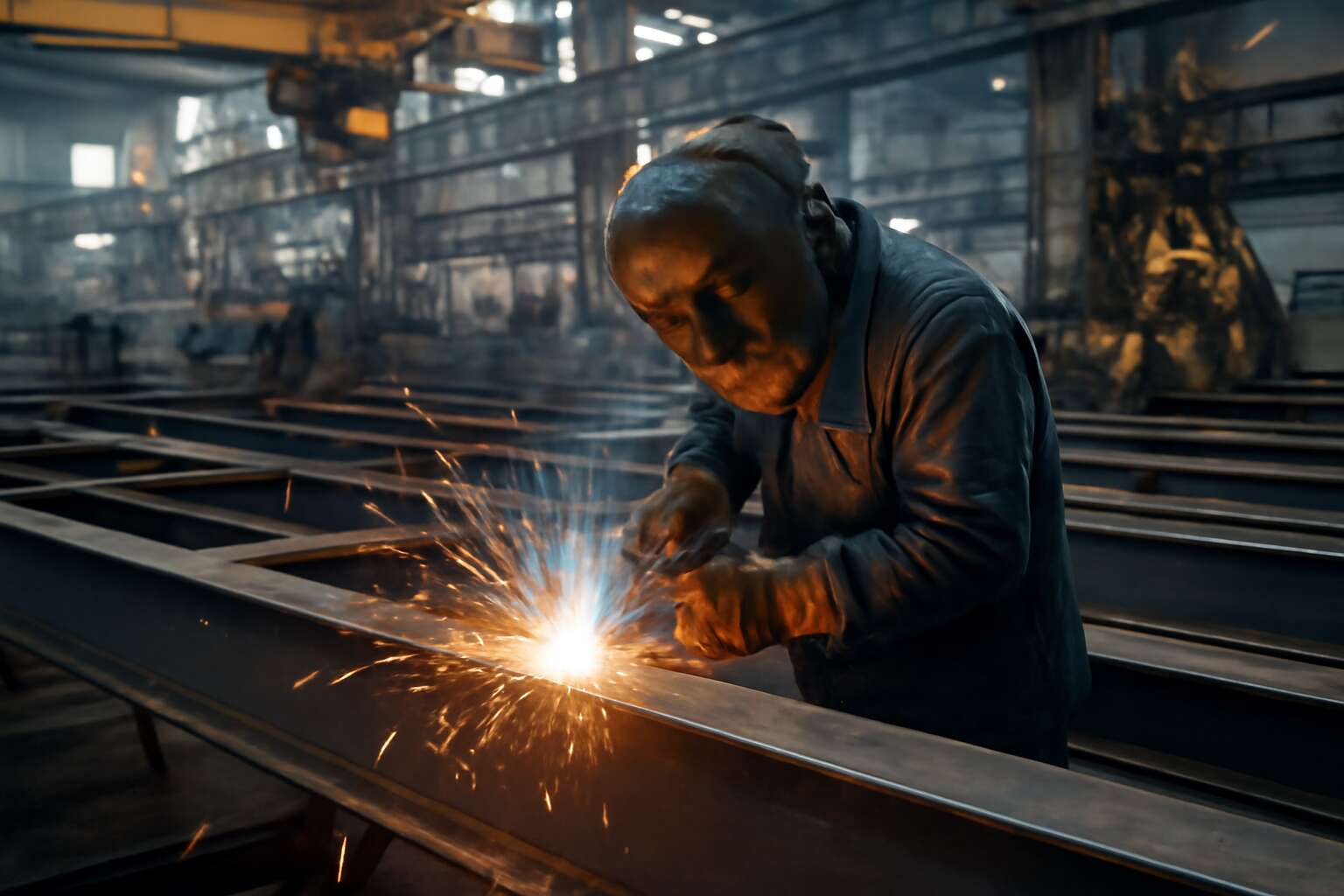
Steel fabrication overview
What is steel fabrication and why it matters
In South Africa’s bustling workshops, steel speaks in quiet thunder. An industry statistic worth noting: steel can be recycled endlessly, turning scrap into the backbone of new structures, from warehouses to bridges.
Steel fabrication meaning isn’t just technical labor; it’s a composition of design, precision, and endurance. It is the process that transforms raw steel into components that bear, fit, and fuse with purpose.
Key steps in the journey include:
- Cutting to exact shapes
- Bending and forming
- Welding and assembly
- Finishing and inspection
Such craft matters because structures endure, safety is built in, and local economies breathe with skilled trades. When steel takes form, it becomes a space for work, family, and possibility.
Key processes in steel fabrication
In South Africa’s workshops, steel work shapes space and possibility. A recent industry note highlights the energy savings from recycling steel, underscoring why fabrication matters. steel fabrication meaning goes beyond cutting metal; it’s turning raw steel into components that carry, connect, and endure.
It blends design, precision, and endurance into real-world results. The process hinges on planning, material quality, and controlled workflows that ensure fit, strength, and longevity in every project.
- Material selection and supplier quality
- Dimensional control and fit
- Joining methods and inspection
- Finish and corrosion protection
With this craft, safety is built in, and projects become durable spaces for work and community. Steel scrap becomes the backbone of new structures—robust, adaptable, and locally powered.
Common materials and alloys used in fabrication
Steel defines space in South Africa’s workshops and skylines, and an energy stat reminds us why: recycling steel cuts energy use by up to 60% from virgin production. That’s the pulse behind steel fabrication meaning—how raw metal becomes something that lasts.
Common materials and alloys keep fabrication practical and resilient. We lean on workhorse steels that balance strength with ductility and corrosion resistance. The core lineup includes:
- Carbon steel for general structural work
- Stainless steel for hubs, enclosures, and coastal projects
- Alloy steels and HSLA grades for high-strength components
Finish matters: coatings, galvanising, and paint systems protect joints and extend life in SA climates. When done well, the mix of material choice and controlled workflows creates durable spaces for work and community.
Industries relying on steel fabrication
In South Africa, “steel fabrication meaning” anchors every new bridge, warehouse, and skyline. The notion isn’t just jargon; it’s a practical promise of strength, adaptability, and long life. Recycling steel cuts energy use by up to 60% versus virgin production, a green wink that keeps projects affordable and resilient.
- Construction and infrastructure
- Mining and power facilities
- Automotive and rail hubs
- Manufacturing plants and equipment
- Coastal and marine projects
From big frames to small brackets, the craft covers it all—delivering durable spaces where people work, collaborate, and dream, long after the spatter from the torch has cooled.
Benefits of steel fabrication in modern construction
In South Africa, steel fabrication meaning anchors every bridge, warehouse, and skyline, turning bold visions into durable realities. Recycling steel cuts energy use by up to 60% versus virgin production, a green wink that keeps projects affordable and resilient.
Here are a few contemporary advantages:
- Speed of erection and modular assembly
- Design flexibility for complex forms
- Durability across coastal and inland conditions
- Lower lifecycle costs through recyclability
In modern construction, the blend of precision, scalability, and on-site speed translates into value for developers and communities alike.
Core fabrication processes and techniques
Cutting and shaping methods
Steel holds its secrets in the heat—the quiet arithmetic of strength and resilience. The steel fabrication meaning isn’t merely metalwork; it’s turning rough stock into trusted frames that bear ambition. A seasoned fabricator insists that ‘Steel speaks when heated, time answers with endurance.’
At the core, cutting and shaping are where vision becomes steel. Core fabrication processes and techniques hinge on precision and control.
- Laser cutting for tight tolerances
- Plasma cutting for speed on thicker sections
- Waterjet cutting for burr-free edges
- Oxy-fuel cutting for heavy ferrous plate
- Shearing for rapid straight cuts
Following cutting, bending, forming, rolling, and punching craft the final geometry, turning flat stock into components that fit like a well-tuned chorus.
Quality emerges in the quiet checks: deburring, alignment, and fit-up ensure consistency from panel to frame. In South Africa’s workshops, heat and discipline forge structures that endure, long after the spark has cooled.
Welding and joining techniques
Welding and joining are the heartbeat of core fabrication processes, turning flat steel into interconnected systems that carry loads and dreams. The steel fabrication meaning reveals itself at the bead where heat meets precision, a silent calculation that binds metal into a confident whole. In practical terms, these joints must resist fatigue, corrosion, and distortion while staying true to design intent.
- MIG welding (GMAW) for fast, versatile joints
- TIG welding (GTAW) for precision and clean welds
- SMAW arc welding for robust, adaptable seams
- Spot and seam welding for panel-to-panel connections
Beyond the flame, engineers in South Africa calibrate heat input, work with local alloys, and validate joints with non-destructive tests. The craft speaks in the quiet confidence of a well-assembled frame, built to endure under the South African sun and the weight of ambition.
Bending and forming processes
A single degree of bend can redefine a structure’s resilience and service life. In that sense, steel fabrication meaning unfolds in the quiet math of forms and loads. Bending and forming are not mere reshaping; they are the art of directing strength along the frame, translating flat sheets into components that carry wind, traffic, and ambition across South Africa’s landscapes.
Core fabrication processes hinge on precise bending and forming. Common methods include:
- Press brake bending
- Roll forming
- Tube bending
- Stretch forming
These techniques demand tight control of material grade, thickness, tooling, and die geometry to ensure consistent geometry and surface finish. In South Africa, operators tailor bending parameters to local alloys and continue with non-destructive testing to confirm geometry, ensuring a well-formed frame that resists fatigue and distortion under the sun and in service.
Finishing and surface preparation
The steel fabrication meaning reveals itself in quiet precision: bending beams, shaving edges, and laying down a finish that outlasts the seasons. A veteran welder once whispered, “Strength is a story told by the surface and the grain of the metal.” From workshops to bridges, it’s the balance of form, load, and wind that keeps communities standing!
Core fabrication relies on precise bending and forming to translate flat sheets into load-bearing components. Finishing and surface preparation ensure the lifecycle, shaping texture and protection.
- Shot blasting to create a uniform surface profile
- Grinding and deburring to smooth edges
- Primer and protective coatings for durable finish
In South Africa, sun and coastal spray test treated steel, so surface prep is vital. Oils are removed, cleanliness is checked, and coatings are chosen for clear days and dust storms. That careful attention keeps structural life honest against fatigue and heat.
Quality control and tolerance management
Precision is the quiet engine behind steel fabrication meaning, turning flat sheets into load-bearing truths through exact cuts and deliberate bends. In South Africa, core fabrication relies on laser cutting, punching, forming, and bending to shape geometry into strength, with tolerance demands that stay constant from drawing to install.
Quality control and tolerance management keep that promise honest. Dimensional checks, fixture fit-ups, and periodic CMM verifications chase perfection, ensuring holes align and edges meet the spec.
- Dimensional verification against drawings
- Fixture and fit-up checks for assembly
- Process capability tracking and final surface checks
Materials, standards, and testing in steel work
Types of steel and specialty alloys
In the workshop’s smoky hush, steel speaks in choices and consequences—the steel fabrication meaning revealed in every bend and joint. A veteran foreman once whispered, “Iron remembers,” and that memory guides how materials are chosen and how testing guards strength at every turn.
Materials, standards, and testing anchor the craft. Carbon steel, stainless, and alloy families form the quiet backbone of projects. Standards thread consistency across South Africa, with SANS aligning to ISO and ASTM references guiding procurement. Rigorous testing—destructive and non-destructive—verifies readiness.
- Materials and grades that meet SANS/ISO/ASTM specs
- Non-destructive testing: UT, RT, MPI
- Documentation and traceability from billet to finished part
Types of steel and specialty alloys expand the design’s vocabulary. Carbon steels for predictable strength, stainless to defy corrosion, and alloy steels tuned for toughness or heat resistance. Specialty alloys such as tool steels and high-strength low-alloy varieties empower precision, longevity, and performance under pressure.
Surface treatments and coatings
Materials and grades that meet SANS/ISO/ASTM specs anchor the craft. Carbon steel, stainless, and alloy families form the quiet backbone of projects, guided by South Africa’s procurement standards. Understanding steel fabrication meaning begins with how materials are chosen, tested, and traced from billet to finished part. Destructive tests and non-destructive testing verify strength and toughness, while meticulous documentation records each step of the journey.
Surface treatments and coatings extend service life and guard against the South African climate. After shaping, a deliberate surface plan—galvanizing, epoxy or polyurethane coatings, and passivation for stainless steels—helps materials endure temperature swings and moisture.
- Galvanizing and metallic coatings
- Epoxy and polyurethane coatings
- Passivation and protective finishes for stainless steel
Coating performance is checked through adhesion, film thickness, and corrosion resistance, with non-destructive checks echoing the broader testing regime. Documentation follows material and coating histories, ensuring traceability from billet to finished part within SANS/ISO/ASTM frameworks—an essential bridge between shop floor reality and client assurance in South Africa’s market.
Fabrication standards and codes
Understanding steel fabrication meaning starts with how materials are chosen, tested, and traced from billet to finished part. In South Africa, procurement standards anchor the craft, aligning with SANS, ISO, and ASTM to ensure consistent strength, weldability, and ductility. Destructive tests push steel to its limits, while non-destructive testing listens for hidden flaws without sacrificing a part’s future. A meticulous ledger grows—heat numbers, batch IDs, and inspection notes—stitching every piece to its origin and purpose.
- Destructive tests
- Non-destructive testing
- Documentation and traceability
Within that framework, materials are matched to service conditions, then documented with certificates that survive field audits. Adherence to these standards creates a reliable bridge between shop floor reality and client assurance in South Africa’s market.
Non-destructive testing and inspection methods
Durability on South Africa’s horizon begins long before the first weld. When materials, standards, and testing align—SANS, ISO, and ASTM in the mix—the project breathes easier. steel fabrication meaning becomes a living definition, guiding choices that endure service conditions. Across SA infrastructure programs, traceability saves up to 40% of field corrections.
Non-destructive testing protects the future of steel, listening for hidden flaws without sacrificing a part’s life.
- Ultrasonic testing (UT)
- Radiographic testing (RT)
- Magnetic particle testing (MT)
- Liquid penetrant testing (PT)
Inspectors log heat numbers and batch IDs to sustain the thread from billet to finished part.
In this framework, documentation and certificates survive field audits, aligning shop-floor reality with client assurance in South Africa’s market.
Durability and corrosion resistance considerations
Durability isn’t something you improvise on the factory floor. Across SA infrastructure programs, traceability saves up to 40% of field corrections. In steel fabrication meaning, the term is about translating specs into a structure that stands up to time, climate, and the peculiar South African winds.
Materials and standards guide every choice. SANS, ISO, and ASTM set the guardrails. Non-destructive testing methods keep secrets safe.
- Ultrasonic testing (UT)
- Radiographic testing (RT)
- Magnetic particle testing (MT)
- Liquid penetrant testing (PT)
Durability and corrosion resistance considerations drive coating decisions and surface preparation. In SA, galvanizing, epoxy coatings, and weathering steels offer a practical shield against coastal salt and inland dust. The goal is a long-lived profile that ages gracefully, not a chemistry experiment you pretend to understand.
Applications across industries
Structural steel for construction projects
South Africa’s infrastructure heartbeat is steel. In this market, more than 60% of major projects rely on structural steel for durability, speed, and adaptability. Understanding steel fabrication meaning helps explain why. It’s the craft of turning raw steel into built forms—columns, frames, and braced systems that stand up to wind, load, and the long witness of time.
Applications span industries—Structural steel for construction projects supports high-rise offices to bridges, warehouses, and industrial plants. In mining, energy, transport, and public works, steel work proves adaptable to harsh environments, rapid assembly, and long life.
- Mining and mineral processing infrastructure
- Power and energy facilities
- Commercial, residential, and public sector buildings
This versatility is the essence of steel fabrication—the quiet force behind safe, efficient construction.
Industrial equipment and machinery fabrication
In this context, steel fabrication meaning is turning raw metal into reliable industrial workhorses that power factories and mines. The craft blends precision with adaptability, shaping frames, supports, and assemblies that stand up to vibration, heat, and time. In South Africa, the demand for robust equipment that can be assembled quickly makes this practice essential for productivity and safety.
Applications across industries include industrial equipment and machinery fabrication.
- Conveyors and material handling systems
- Machine frames and structural housings
- Hydraulic cylinders and pump components
The outcome is safer, more efficient plants across SA.
Architectural steel for aesthetics and function
In South Africa’s cities, architectural steel stands as more than a framework; it is a language of light and endurance. The steel fabrication meaning in practice is the artistry of turning raw metal into frames that breathe with buildings—performing as much as they impress. Across industries, architectural steel is employed not only for structural heft but for the way it shapes skylines with clarity, texture, and rhythm.
- Facade systems and cladding
- Staircases, balustrades, and canopies
- Exposed structural elements that read as sculpture
From office lobbies to cultural venues, these components marry aesthetics with function, offering longevity and ease of maintenance under South Africa’s climate. The result is spaces that feel both confident and inviting, where form follows robust, practical purpose.
Energy and utility sector applications
Across South Africa’s energy landscape, steel fabrication meaning translates into reliability. “Steel is the spine of modern infrastructure,” a seasoned engineer once noted, and it’s the quiet force behind grid upgrades and utility projects. In energy and utilities, this craft yields durable frames and supports that endure heat, dust, and shifting loads, keeping plants humming and networks resilient.
- Power plants and substations
- Transmission towers and grid infrastructure
- Renewable energy projects, including solar farms and wind turbines
These applications demand rugged components that ease maintenance and extend service life, underscoring how steel work supports the country’s evolving energy future.
Maintenance, repair, and retrofitting projects
Maintenance, repair, and retrofitting projects test the grit of any operation. The steel fabrication meaning, in plain speak, is turning raw metal into reliable frames and mounts that can be swapped or upgraded as equipment evolves without halting production. It’s the quiet flex that keeps lines moving and bosses smiling during downtime.
- Component upgrades to extend service life
- Obsolete equipment replacements aligned with new codes
- Retrofitting for enhanced safety and accessibility
Across South Africa, maintenance teams in mining, manufacturing, and utilities lean on rugged steelwork to minimize disruption. The idea is straightforward: durable components that resist heat, dust, and shifting loads while easing ongoing maintenance and future upgrades. It’s steel showing up when the job actually matters!
Partner selection and project execution
How to evaluate a steel fabrication partner
Across South Africa, projects that align with a seasoned fabricator finish faster and with fewer costly surprises. The steel fabrication meaning is more than a definition—it’s a compass, guiding procurement, scheduling, and on-site collaboration toward a single, dependable horizon.
To evaluate a partner for this quiet revolution, seek clarity, consistency, and craft. Consider these criteria:
- Track record of projects similar in scale and sector
- Financial stability and a transparent pricing model
- Proactive communication, project management tools, and on-site support
With a chosen collaborator, execution unfolds like a measured performance: design alignment, transparent milestones, and a governance rhythm that catches risks before they become drama. When communication flows, so does progress, and the steel speaks in straight lines and sturdy promises.
Cost estimation and budgeting for fabrication
Partner selection for steel projects acts as a compass, turning vague promises into visible milestones and budget clarity. In South Africa’s market, the steel fabrication meaning is more than a definition: it is a framework that aligns procurement, scheduling, and on-site collaboration toward one horizon. Early conversations should pin down scope, lead times, and how cost estimation will be handled—before a thread is cut.
- Transparent cost breakdown by stage (design, detailing, fabrication, surface treatment)
- Contingency allowances based on risk assessment and market volatility
- Milestone-based payments synchronized with verified progress
Once partner chosen, governance rhythms, design alignment, and proactive risk logging keep the project steady.
Project planning, timelines, and communication
Locking in a reliable partner before the first thread is cut is the quiet accelerator of success in South Africa’s steel fabrication meaning. In practice, partner selection acts as a compass, aligning procurement, scheduling, and on-site collaboration toward one horizon. A well-chosen collaborator translates vague promises into concrete milestones and transparent budgeting, letting design decisions meet reality on site. In this phase, set expectations on lead times, roles, and how cost estimation will be handled, so confusion can’t hide behind a welding torch.
Project planning and execution then rely on governance rhythms: regular reviews, design alignment checks, and proactive risk logging to keep the project steady. Clear, human-driven communication turns complexity into choreography rather than chaos.
Quality assurance, safety, and compliance
Understanding steel fabrication meaning anchors this conversation. Partner selection acts as a compass, aligning procurement, scheduling, and on-site collaboration toward one horizon. A well-chosen collaborator translates vague promises into concrete milestones and transparent budgeting, letting design decisions meet reality on site. In this phase, set expectations on lead times, roles, and how cost estimation will be handled, so confusion can’t hide behind a welding torch.
Governance rhythms then keep it steady: regular reviews, design alignment checks, and proactive risk logging. In this human-driven cadence, quality assurance and safety become the quiet engines of progress.
- Quality assurance systems that verify geometry, weld integrity, and finishes
- Safety and compliance protocols aligned with South African codes and standards
Together, these threads weave a narrative of resilience, where every steel element earns its place in a city’s fabric with grace and grit.


0 Comments