Understanding the Fabrication Process
Step-by-Step Overview of Aluminum Fabrication
Every window begins as a length of raw alloy, a thing of humble grey potential. The process of aluminum doors and windows fabrication demands patience, a steady hand, and an almost obsessive respect for measurement. A mistake of two millimetres here becomes a draft that whistles through a seal a decade later, a small ghost haunting the home.
The journey starts with the cutting of the profiles, where precise mitre corners are born from the screech of the blade. After this, the frames are assembled on sturdy jigs, the corners pinned and screwed into place while the spirit level watches over the work. The fabrication of these systems is a quiet art, one where the silence of the workshop is broken only by the pneumatic hiss of drills and the rhythmic thump of rubber mallets seating the glass.
With the skeleton formed, the focus shifts to the preparation of the components:
– Machining the drainage holes to allow the rain to escape
– Crimping the corner joints for immense structural rigidity
– Inserting the thermal break strips that separate the interior from the exterior
– Drilling the weep vents and hardware mortises
Once the frame is true and square, the glass is bedded onto setting blocks, and the glazing beads are tapped into place to hold the pane fast. The moving parts, the hinges and the locks, are then installed with a careful tension so the door swings heavy and silent. This entire ballet requires machinery that is calibrated daily and skilled hands that understand the temperament of the material. It is a craft that turns simple lengths of metal into the barriers between comfort and the wild South African weather.
Cutting and Machining Techniques
Tenths of a millimetre determine whether a window seals for decades or whistles from the first storm. In aluminum doors and windows fabrication, this precision begins with the cutting station.
Operators programme double mitre saws with blade angles accurate to 0.1 degrees. Any residual play in the bed guides rejects itself as a mismatched joint. Nudging the profile during the cut creates a curve that no assembly jig can correct.
Machining requires equal discipline. Each lock, hinge and drainage opening is routed with CNC equipment. The profile moves through multiple stations for:
- End milling of the stile ends
- Drilling of hardware fixing holes
- Notching of the thermal break zone
Tool wear accumulates unnoticed. Dull cutters leave burrs that trap moisture and encourage corrosion years later. A fabricator who checks tools daily protects the whole unit’s performance. Aluminum doors and windows fabrication rewards this obsession.
Assembling Frames and Panels
Assembly is where the separate parts either align or betray the work done before. Corner crimping presses the mitred profiles together, but the machine only responds to what the operator’s hands have prepared. A frame that sits twisted on the table transfers that twist to the glass. The panel becomes the evidence of every earlier decision.
Gaskets demand patience. Rolled in too fast, they stretch and pull away from the corner keys. Glass units rest on setting blocks that carry the weight, never the frame edges. Each screw, each clip, each sealant bead is a deliberate act.
The human element here is quiet vigilance. Aluminum doors and windows fabrication lives or dies in this stillness.
Glazing and Sealing Methods
Glazing turns the assembled frame into a finished barrier, but the transformation is unforgiving. The glass unit settles onto its setting blocks, and the sealant follows in a continuous, steady line. A bead that runs cold or uneven invites moisture to find its way inward, where it will corrode the metal over time. There is no second chance once the compound skins over.
Sealing methods in aluminum doors and windows fabrication demand patience and a steady hand. Structural silicone bonds the glass to the frame for high-rise performance, while compressed gaskets offer a mechanical grip that allows for thermal movement. Each approach carries its own risk.
- Wet glazing relies on sealant as the primary weather barrier, best for irregular openings.
- Dry glazing uses preformed gaskets, favouring repeatable, clean installation.
The choice depends on pressure ratings, climate exposure, and how the building will move in the wind.
Choosing Materials and Finishes
Aluminum Alloy Grades and Their Applications
The selection of an alloy grade is a quiet negotiation with your environment. In South Africa, where coastal salt and high UV levels test every exposed surface, the choice between 6063 and 6061 becomes existential. Every aluminum doors and windows fabrication project carries this weight. 6063 offers superior extrudability and a smoother surface for finishing. 6061 brings greater tensile strength, though it resists complex shapes.
Consider the application before you commit:
- 6063 for window frames and curtain walls
- 6061 for structural door sections and heavy-duty frames
Finish selection follows the same logic. Anodizing creates a metallic bond with the substrate. Powder coating offers color flexibility and impact resistance. Both require correct pre-treatment, a step that determines longevity in ways unseen but deeply felt. The surface you choose determines how the structure endures the years.
Thermal Break Profiles for Energy Efficiency
At 1,700 metres above sea level, Johannesburg’s winter nights test every building envelope. The aluminium frame, without intervention, conducts cold straight into the room. Thermal break profiles interrupt this path with a polyamide chamber, placed between the inner and outer metal sections. The result is a frame that stays close to room temperature, even when frost settles on the glass.
Choosing materials and finishes for this climate means looking beyond the visible surface. When you specify a thermal break profile, consider the width of the chamber and the quality of the polyamide. The right finish protects the substrate, while the thermal profile protects the interior.
- Wider thermal chambers slow heat transfer with greater effect.
- Glass fibre reinforced polyamide adds structural rigidity.
- Precision extrusion tolerances keep the seal intact for decades.
Every aluminum doors and windows fabrication project carries this responsibility. The materials chosen today will answer for their performance through every winter that follows.
Powder Coating and Anodizing Options
Approximately 90% of Highveld ultraviolet exposure damage manifests as surface oxidation, not structural failure. Powder coating and anodizing are the two serious contenders for guarding against this relentless decay, but they are not interchangeable choices in South Africa’s demanding climate.
Powder coating creates a durable polymer layer, effectively sealing the aluminum doors and windows fabrication substrate from corrosive elements like acid rain and airborne pollutants common in industrial zones. This thermosetting finish can reach a thickness of 60 to 120 microns, providing substantial physical resistance against scratching from daily handling and high winds.
Anodizing, by contrast, changes the metal itself. The process converts the surface layer into aluminium oxide, a dense crystalline structure that becomes an integral part of the profile. It cannot peel or chip because it does not sit on top of the metal, it becomes the metal. However, this finish requires a higher grade of alloy, often a 6063 grade with specific tempering, to achieve optimal consistency.
When selecting between these systems for your project, consider the performance variables that matter most in Gauteng:
– Salt spray resistance for coastal applications versus particle pollution for Highveld sites.
– Colour stability under intense UV radiation, where certain bronze anodized shades outperform others.
– Maintenance protocols that dictate whether a simple wash or a solvent-based regimen is acceptable.
The finish you choose becomes the permanent interface between the structural profile and the atmosphere. It determines the year-round response to Johannesburg’s sudden temperature shifts, where afternoon solar gain can raise a dark surface temperature by 40 degrees Celsius. In this context, the visible appearance is secondary to the measured performance of the molecular barrier you have specified. The honest account of a South African winter will be written across any frame that settles for a finish without a verifiable history in this exact sunlight.
Hardware and Fastener Selection
Fasteners hold the assembly together, yet they also create the weakest electrochemical link in any aluminum doors and windows fabrication project. In Gauteng’s Highveld atmosphere, where sulphur dioxide combines with moisture, standard zinc-plated screws begin to corrode within months. The practical solution is austenitic stainless steel, 304 grade for inland sites and 316 for coastal exposure near Durban or Cape Town.
Hardware deserves the same scrutiny as the extrusion itself!
– Hinges supporting heavy double glazing need adequate wall thickness or they deform under cyclic loading.
– Thermal break profiles require screws that do not bridge the polyamide strip.
– Fittings must match the powder coated finish across production batches.
I have watched good aluminum doors and windows fabrication fail at the hardware stage. The profile cannot outlast the components attached to it.
Glass Types for Doors and Windows
Once your aluminum doors and windows fabrication has advanced past the extrusion phase, a critical choice emerges: the glass itself. In South Africa, glazing can account for nearly forty percent of a building’s total heat loss, a figure that often surprises homeowners focused purely on frame materials. The glass becomes the primary barrier against the Highveld’s harsh ultraviolet rays and the coastal humidity that corrodes lesser components.
Selecting the correct pane requires a methodical approach that matches the frame’s structural integrity with the glass’s thermal performance. The process is not arbitrary; it demands precision.
1. Opt for double glazing in Gauteng to mitigate the dramatic temperature swings between day and night.
2. Consider laminated glass for security applications where forced entry is a concern in metropolitan areas.
3. Evaluate low-emissivity coatings to reflect solar heat gain without sacrificing natural daylight.
The interaction between the glass type and the frame’s powder coated finish dictates the longevity of the installation. A high-performance glass unit held by a beautifully finished profile still fails if the sealant and setting blocks are not compatible. Your commitment to aluminum doors and windows fabrication must extend to the transparent elements, ensuring the entire assembly operates as a single, cohesive system under structural loading.
Key Machinery and Equipment
CNC Cutting and Milling Machines
In the unforgiving world of aluminum doors and windows fabrication, a fabrication machine is your tyrant and your salvation. There is no room for guesswork. The saws, routers, and drills must operate with a clinical precision that mirrors a surgeon’s scalpel, for a single millimeter of error transforms a premium thermal break profile into expensive scrap metal.
At the heart of modern efficiency sits the CNC machining center. These automated beasts eliminate the mundane errors of manual handling, ensuring that every mitre and drainage slot is placed with ruthless accuracy. The programming is the true art form. When you upload the cut list, the machine takes over, spinning and cutting the aluminum extrusions with a consistency that human hands simply cannot match. This consistency is the bedrock of profitability.
The cutting machines themselves have evolved. Double-head cutting saws now offer automatic blade rotation and precise positional stops. They handle the primary mitring, while CNC milling machines perform the intricate work of creating hardware mortises and hinge recesses. The real secret lies in the clamping force and blade lubrication; without them, the blade leaves a burnished edge that ruins the anodizing finish.
– Milling spindles manage variable speeds to handle different alloy grades.
– Automatic tool changers reduce cycle times between operations.
– Hydraulic clamps hold complex profiles securely, preventing vibration chatter.
What separates a top-tier operation from a backyard garage setup is the investment in these specific pieces of kit. Every profile that passes through a CNC router emerges with a tolerance of less than half a millimetre. Consequently, the assembly lines fit together seamlessly, and the glazing process becomes significantly faster. This investment is the only way to survive the competitive landscape of South African construction supply. Your machinery is the silent guardian of your quality control, and it never sleeps.
Pneumatic and Hydraulic Presses
Pneumatic and hydraulic presses deliver the force that CNC machines cannot. A pneumatic press slams a crimp into a corner joint with a percussive thud. A hydraulic unit applies steady pressure for deeper forming tasks. Neither tolerates hesitation.
These machines matter in aluminum doors and windows fabrication because frame integrity depends on mechanical joints, not just welds. The press creates a cold joint, one that holds its shape under extreme thermal expansion.
– Pneumatic presses excel at high-speed crimping and staking.
– Hydraulic presses handle thicker extrusions and deeper draws.
– Both require regular calibration to maintain consistent output.
Without this force, profiles shift during assembly. That is how leaks start and hinges bind. The press removes the variable.
Welding and Joining Tools
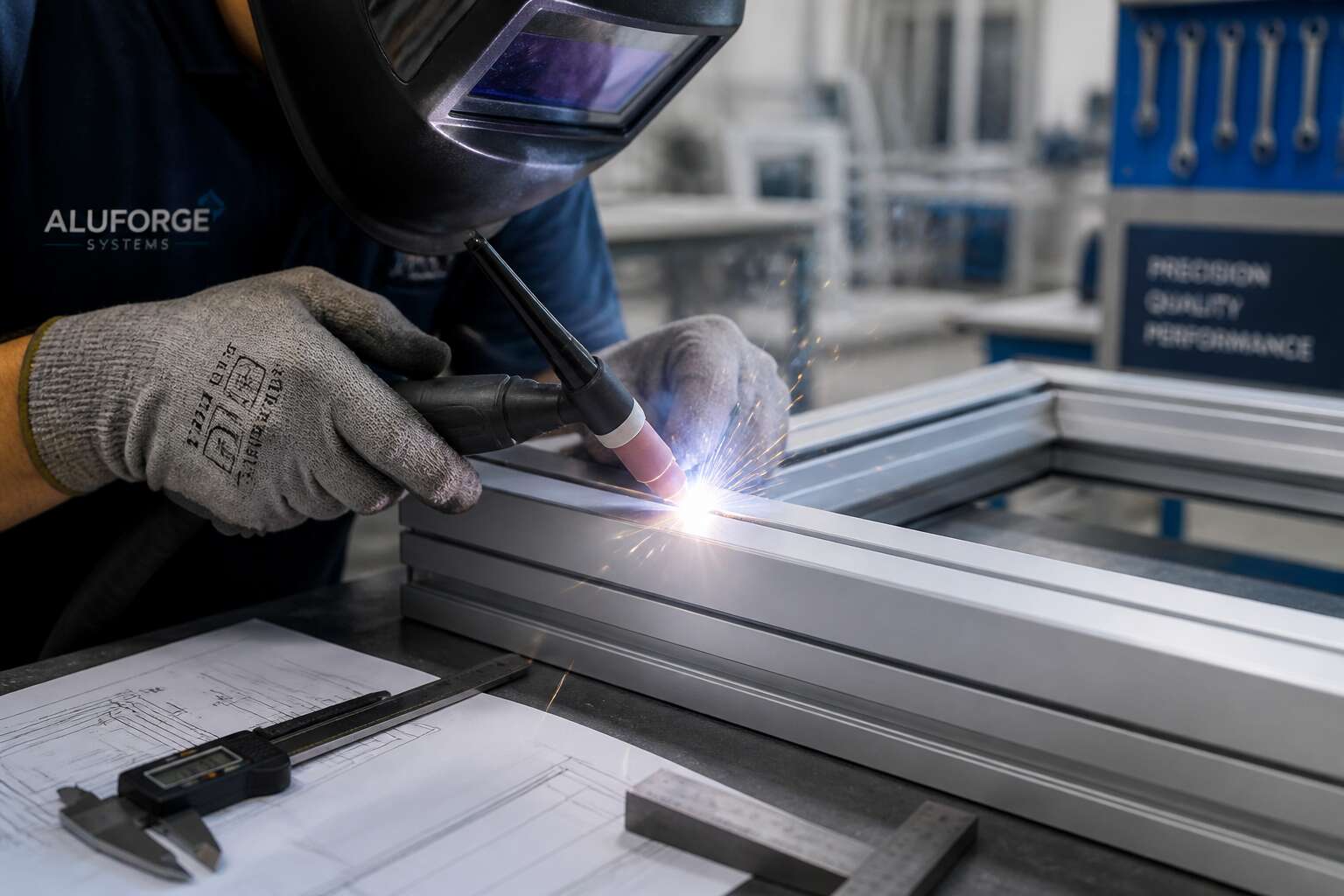
A TIG torch does not care about your deadline. It demands clean surfaces and steady hands. Welding is where aluminum doors and windows fabrication lives or dies. Skip the argon and you will see porosity within seconds. A welder’s job is to join profiles without weakening the temper. Poor heat control turns a rigid frame into a floppy one. We prefer syncro pulse TIG units in our shop. They let the operator balance AC frequency while walking the cup.
MIG units work for thicker sections. They run faster but leave more spatter. Friction stir welding needs no filler rod at all, though heavy fixtures are mandatory. Salt air on the Cape coast punishes lazy welds, so rinse off flux residue and recheck geometry.
- Pull-type rivet guns for blind joints
- Torque-controlled screwdrivers for stainless fasteners
- Edge routers for deburring welds
Each tool earns its space on the bench. Without them, the whole aluminum doors and windows fabrication process falls apart.
Surface Preparation and Paint Systems
A rainstorm on the Highveld reveals the truth about a poorly prepared paint line. Water beads on a flawless surface, or it soaks into a dull, washed-out film. That final finish is the only thing a homeowner touches. The machinery behind that surface, therefore, deserves close attention.
Preparation happens in a controlled environment before any spray gun fires. We run a three-stage chemical pretreatment line that cleans, etches, and conversion coats the extrusions. This process creates a tooth for the powder to grip. Typical symptoms of hurried preparation include:
– Shedding paint after two seasons.
– Filiform corrosion creeping under the film.
– Uneven gloss across a single profile.
The spray booths themselves maintain a specific temperature and humidity level. A dry booth with the correct extraction airflow pulls overspray away cleanly. We use electrostatic spray guns for powder coating on our aluminum doors and windows fabrication line, which charges the particles to wrap around edges. Inside the curing oven, the temperature climbs to around 200 degrees Celsius to melt and flow the powder into a continuous skin.
Paint systems for coastal towns like Durban require a polyester base. Raw aluminum will not accept paint directly. The conversion coating is the anchor. We also use a thermal spray unit for zinc application in highly corrosive areas. It is a gritty, noisy step, but it extends the frame’s lifespan by decades. Without these systems, the precision of the weld is invisible and irrelevant. The surface work is where a product earns its place on a Cape Town home.
Measurement and Alignment Instruments
In aluminum doors and windows fabrication, a frame that looks square to the naked eye can be out by three millimetres. That gap becomes a draught, then a squeak, then a failure. Measurement and alignment instruments exist to prevent this.
We keep digital calipers, micrometers and dial indicators within reach at every workstation. Laser levels and digital protractors check the squareness of welded corners before the frame moves on. A surface plate, flat to a tenth of a millimetre, checks twist or bow in extrusions.
The alignment jigs are machined from solid steel. They hold each frame in a precise position while the welds cool. If the jig is off, every frame that passes through inherits that error. We calibrate these tools weekly. It is unglamorous work. It is also the difference between a window that seals weathertight for twenty years and one that leaks after the first Highveld storm.
Maintenance and Safety Equipment
Machines in aluminum doors and windows fabrication fail gradually, through ignored rattles, low hydraulic fluid, and filters choked with aluminium dust. Our maintenance schedule is relentless! Every press, saw and CNC spindle gets its lubrication checked at the start of each shift. Full inspections happen weekly, and we replace worn seals before they start leaking.
Safety equipment deserves the same ritual. Guards, interlocks and emergency stops are tested daily. Operators wear:
- Impact resistant goggles and face shields
- Cut resistant gloves for handling sharp extrusions
- Hearing protection rated for high frequency saw noise
A single skipped check turns a reliable machine into a liability. There is no room for shortcuts.
Quality Control and Compliance
Industry Standards and Certifications
Quality control in aluminum doors and windows fabrication often determines the difference between a frame that lasts decades and one that fails after a few seasons. Every batch passes through dimensional verification and seal integrity checks.
For South African manufacturers, compliance with SANS 61301 and SANS 10400 is non-negotiable, especially when wind loading and water penetration are tested locally. Certifications such as the Agrément South Africa mark provide third party confidence. However, certification is only useful if the workshop follows it daily.
Our quality line includes:
- material traceability reports
- torque calibration logs
- pressure test records
These documents protect both the fabricator and the client. Without rigorous audits, standards become meaningless. That is why we treat every inspection as a fresh opportunity to catch deviations early!
Inspection and Testing Procedures
A frame’s true character only surfaces under duress, when the Highveld winds test its seals or a summer downpour probes its joints. Documentation tells you what should happen; field performance reveals what actually does. That distinction is why our inspection procedures focus on process verification, not just final appearances.
We sample profiles during production, not only at dispatch. This catches dimensional drift early, when recalibration is still straightforward. The testing matrix for aluminum doors and windows fabrication includes water penetration trials and simulated wind loading, each recorded and filed.
Inspection steps we follow:
– Verify mitre alignment before welding
– Check gasket compression after glazing
– Audit hardware torque settings
– Confirm drainage paths are clear
These checks are unglamorous. They are also the reason a system performs predictably for decades, which is the only guarantee that truly matters.
Weather Resistance and Durability Testing
No certificate stops corrosion. Rain seeps, UV degrades, and wind tests every joint. In aluminum doors and windows fabrication, weather resistance and durability testing exist to answer one question: how long until this product fails? We simulate that failure before dispatch.
Our testing includes accelerated weathering, salt spray exposure, and thermal cycling. Each sample is pushed past its rated limits. Compliance with SANS 613 and equivalent standards is the starting point, but field conditions exceed laboratory assumptions.
Durability testing also covers hardware and seals under repeated operation. Some failures appear after 10,000 cycles. Others take one violent storm. We replicate both.
Common Defects and Prevention
In our experience, a single misaligned corner can invalidate an entire production run. That is why quality control in aluminum doors and windows fabrication depends on catching defects before they compound. Common issues include poorly fused welds, uneven powder coating thickness, and gaskets that sit crooked in their grooves. Each one changes how the product performs in the field.
- Weld porosity that weakens frame corners
- Incorrect miter cuts leading to visible gaps
- Hardware holes drilled off center
Prevention starts with tool calibration and ends with compliance checks at every station. We measure twice and still verify with jigs, because human error never disappears entirely. A small adjustment in blade speed or a worn roller can introduce the same defect across dozens of units. So we audit our own work daily, and that habit keeps our scrap rate low.
Documentation and Traceability
One customer audit changed how we view paperwork. The documentation of aluminum doors and windows fabrication is not an afterthought; it is a permanent record. Without traceability, a defective component disappears into the completed frame.
We maintain three layers of compliance records:
- Mill certificates for every aluminum batch
- Logged machine calibration data for welds and cuts
- Timestamped quality checks at assembly stations
Traceability lets us follow a single screw from shipment to installation. When a sealant cures poorly, we retrieve the batch number and the technician’s initials within minutes. This accountability is what separates controlled production from guesswork.
Cost Estimation and Project Planning
Material Cost Breakdown
The difference between a profitable project and a costly miscalculation surfaces in the material cost breakdown. For aluminum doors and windows fabrication in South Africa, sourcing extrusion profiles represents a large portion of your budget. I watch the rand closely because the aluminium billet price fluctuates globally, shifting your quote within days.
Estimating requires a precise calculation of profile lengths, glass square metres, and gasket run. The frame extrusion alone can consume 35% of material spend. Hardware, sealants, and fasteners add another layer. I allocate a scrap allowance of 4% for offcuts and machining errors.
A reliable plan hinges on these material considerations:
- Extrusion weight and finish selection.
- Glass type and thickness.
- Gaskets, thermal break profiles, and sealants.
- Hardware, fasteners, and imported components.
Each element requires a cost per unit verified against supplier invoices. My planning process reviews this breakdown weekly. During aluminum doors and windows fabrication, the true price of your product appears only when you align material costs with factory throughput.
Labor and Overhead Calculations
The true cost of labor in aluminum doors and windows fabrication extends far beyond the hourly wage on a payslip. I calculate the fully loaded rate for every technician on the floor. This figure includes medical aid contributions, UIF, annual leave pay, and the quiet cost of idle time between production runs. In South Africa, skilled fabricators are the backbone of a reliable factory, and their efficiency directly influences your profit margin.
Overhead calculations often catch new workshops off guard. A clean, well-lit factory floor is not a luxury; it is a productivity engine. My overhead breakdown follows a simple logic:
– Factory rental and municipal rates per square meter.
– Electricity for machinery, compressors, and extraction systems.
– Tooling replacement costs, including saw blades and drill bits.
– Insurance premiums and general equipment maintenance.
– Administrative salaries and software licenses for quoting.
I allocate these expenses against the total productive machine hours per month. Dividing your fixed costs by available hours reveals the true breakeven rate for every minute of production. When I quote a project, I multiply this overhead rate by the estimated fabrication hours. This calculation transforms a simple material quote into a comprehensive price. Without this step, a busy factory can still bleed money. The price for aluminum doors and windows fabrication must absorb these silent costs to sustain a healthy workshop.
Fabrication Time and Lead Times
Estimating fabrication time is where precision meets reality. Every cut, weld, and seal carries a measurable duration, and I track these against past production runs to build accurate forecasts. A standard window frame might require two hours of machine time, while a custom door system can consume a full day.
Lead times depend on this calculation. When a client asks for a completion date, I work backwards from the fabrication schedule, factoring in powder coating turnaround and glass supplier delivery. The aluminum doors and windows fabrication industry in South Africa demands this level of planning. A realistic lead time protects your reputation and prevents costly rush orders.
For a typical residential order, consider these time allocations:
- Frame cutting and machining: one to three days
- Assembly and welding: two to four days
- Glazing and hardware installation: one to two days
These estimates shift with complexity and current workload. Accurate aluminum doors and windows fabrication timelines come from documented history. I review every project’s actual hours against the estimate, refining with each cycle.
Customization vs. Standard Profiles
Cost estimation in aluminum doors and windows fabrication often feels like a balancing act between client desire and workshop reality. Custom profiles demand dedicated tooling and often sacrifice material efficiency, as offcuts are harder to repurpose. Standard stock, by contrast, allows for predictable waste calculations. The decision between the two changes your entire cost model.
Customization shifts the fabrication schedule significantly. A bespoke extrusion might require a three week wait from a supplier in Gauteng. That lag affects project planning immediately. For a recent commercial facade, we built cost estimates around these variables:
– Powder coating color matching surcharges
– Increased machine setup time for unique cuts
– Specialized glazing beads and gaskets
– Rework allowance for fit adjustments
Standard profiles simplify the estimate. Procurement is a phone call away, and your labor hours are known from past runs. However, standards limit your design options. In the South African market, striking a balance means understanding that the true cost of aluminum doors and windows fabrication includes the price of waiting. The wise estimator chooses profiles that align with both the aesthetic and the deadline.
Pricing Strategies for Contractors
Pricing aluminum doors and windows fabrication projects in South Africa rewards the paranoid estimator. The quote you send on Monday can be obsolete by Thursday when the aluminium supplier adjusts their surcharge!
We learned this on a job in Durban where the client’s payment terms stretched to 60 days. Our pricing strategy now factors in the time value of money. Waiting for payment is a loan you never agreed to make.
A realistic quote for aluminum doors and windows fabrication accounts for variables that do not appear on the architectural drawing:
- Site storage security for frames delivered early
- Crane hire when a lift is unavailable
- Rebooking installation teams after weather delays
These items are awkward to discuss with clients, but they belong in the quote. Omitting them makes your price look attractive and your profit margin fictional.
Challenges and Best Practices
Handling Complex Geometries
The leap from a standard square frame to a sweeping, architectural arc or a sharply angled bay window is where fabrication truly separates the craftsmen from the assembly lines. In South Africa, where design trends often mimic the dramatic lines of international modernism, the pressure to deliver complex geometry is immense. We find that the most significant hurdle is not the initial cutting, but the preservation of structural integrity when a profile is mitered at an unconventional angle, or when a curved section demands a specific extrusion. It is a dance between the CNC machine’s capability and the inherent limitations of the aluminum itself, a factor that every serious aluminum doors and windows fabrication operation must respect.
Working with drawn or bent profiles requires a rethink of the standard assembly line approach. The subtle warping that occurs after welding a complex joint can compromise the entire unit’s seal, leading to thermal leaks and water ingress issues down the line. Our process hinges on meticulous measurement and a tolerance for zero error, often using custom jigs to hold components in place during assembly. It is during these phases that we rely on empirical data, rather than guesswork, to predict how the metal will behave under stress.
When tackling these demanding shapes, we adhere to several non-negotiable practices:
– Verify the radius of any arched profile exceeds the manufacturer’s minimum bend allowance to prevent micro-fractures.
– Use a slower feed rate on the CNC spindle to reduce vibration on thin, thermally broken profiles.
– Simulate the final load bearing weight of the glass before committing to the frame’s design.
The aesthetic payoff is significant, yet the margin for error remains thin. A single miscalculation in the math of a compound angle can result in a gap visible to the naked eye, undermining the perceived quality of the installation. We have learned that the most successful aluminium doors and windows fabrication projects are those where the design team and the workshop are in constant dialogue. The workshop’s feedback on the feasibility of a complex node often saves the client time and money, proving that communication is just as critical as the machinery on the floor. Ultimately, mastering complex geometries is about respecting the material’s limits while pushing the boundaries of what is architecturally possible.
Preventing Corrosion and Galvanic Reactions
Corrosion damages aluminum doors and windows fabrication projects in South Africa’s coastal regions. The salty air along the Durban or Cape Town coastline accelerates galvanic reactions whenever dissimilar metals contact. We see it most often where stainless steel hardware meets untreated aluminum profiles. That interface becomes an electrochemical cell, and the aluminum acts as the sacrificial anode.
Prevention starts at material selection. We isolate metals with nylon washers or rubber gaskets. We specify marine grade fasteners for any project within ten kilometers of the ocean. A simple change in fastener material can extend a window’s lifespan by decades.
- Use Teflon coated separators between aluminum and steel components.
- Apply anti corrosion paste to threaded joints before assembly.
- Seal all exposed cut edges after machining.
Proper drainage in the frame design prevents water pooling, which is the electrolyte that drives the reaction. Our aluminum doors and windows fabrication process includes a mandatory inspection for bi metallic contact before powder coating.
Achieving Precise Tolerances
Achieving precise tolerances in aluminum doors and windows fabrication demands more than a calibrated CNC machine. The material itself shifts. Heat from welding causes expansion, and the profile can pull slightly out of square as it cools. In Gauteng’s fluctuating climate, we allow the metal to rest before final machining.
Every measurement needs verification at multiple stages. Our workshop uses digital callipers and laser alignment tools, but the human eye still catches what instruments miss. A 0.5 millimetre deviation on a transom joint becomes a visible gap once powder coating adds thickness.
- Measure the profile before cutting, after cutting, and again after welding.
- Use jigs that hold the frame square during the cooling phase.
- Document every deviation to refine the process.
This discipline is what separates reliable aluminum doors and windows fabrication from work that fails on site.
On-Site Installation Issues
The best fabricated frame still encounters its most demanding conditions on site. Walls are rarely perfectly plumb, and openings shift after concrete cures. In Gauteng, where afternoon thunderstorms and high UV exposure are routine, installation crews must adapt quickly.
We learned to measure the actual opening before delivery, not just trust the architectural drawings. A 3 millimetre difference in the rough opening can compromise the entire anchoring strategy. Our teams use laser levels and shim packs, but experience still reads building movement patterns that instruments miss.
Common installation pitfalls include:
- Fixing frames too rigidly before thermal expansion sets in
- Sealing the exterior before verifying drainage paths
- Using incompatible fasteners that trigger galvanic corrosion
These problems trace back to aluminum doors and windows fabrication choices, because installation reveals every shortcut or compromise made in the workshop. A frame that shifts after fixing was never truly square to begin with!
Tips for Efficient Workflow
Wasted hours in a fabrication shop rarely come from slow machines. They come from chaotic workflow, where materials sit in the wrong place and rework strips profit margins. Efficient production is the real difference between surviving and thriving in this industry.
A proper workflow starts with a clear signal path from intake to dispatch. Every aluminium profile must have a designated staging area before it touches a saw. This prevents the pile-up that causes scratches and mistakes.
– Group all components for a single job in one trolley.
– Mark every cut piece immediately with the job number.
– Set up tooling for the next task while the machine finishes the current one.
– Keep consumables like screws and gaskets within arm’s reach of assembly benches.
These small habits compound over a week. A shop that moves materials once, not three times, cuts labour hours dramatically. In the context of aluminum doors and windows fabrication, this discipline is non-negotiable. The workshop floor is a dynamic environment, and adopting a lean approach to movement delivers immediate results. Teams that master this flow produce higher quality frames with fewer callbacks. The system must be simple enough for new staff to grasp on day one, yet robust enough for peak production seasons. This is how you turn a busy workshop into a profitable one.
Training and Skill Development
Most training budgets fail before the first cut. In aluminium doors and windows fabrication, the cost is not the machine; it is the operator who never learned to read deflection in a profile. I have watched certified technicians struggle because their training stopped at a safety video!
The challenge in South Africa is that skills pass down informally, creating echo chambers where bad habits thrive. Structured competency checks break this cycle. Separate what workers claim to know from what they can prove under pressure.
- Assess every operator against written standards, not tenure.
- Pair each new hire with a mentor who documents errors.
- Repeat calibration drills monthly, because skill decays.
Training is not an event. Aluminium doors and windows fabrication demands a continuous loop. When your team understands the reasons behind each weld and seal, rework drops and trust rises. That separates a crew that performs from one that appears busy.


0 Comments