Understanding Fabrication in Everyday Language
Definition and Core Concept
What does it truly signify when someone seeks an explanation for fabrication meaning? In everyday language, fabrication is the act of constructing something from raw parts, whether that is a physical object or a story. The core concept rests on deliberate assembly, not accidental formation. A metalworker shapes steel with purpose, and a person crafting a falsehood does the same. The word always points to human intervention.
For fabrication meaning, the essence is agency. Consider these aspects:
- The material basis, from alloys to narratives
- The conscious choice of the builder
- The resulting object, be it a bridge or a lie
This term clarifies how we describe intentional creation in daily life. It appears in legal rooms and welding bays alike, always carrying a sense of constructed reality.
Common Usage in Manufacturing
Fabrication carries two opposing senses. A fabricated invoice is a criminal act. A fabricated steel beam is a product of exact work. When someone searches for fabrication meaning, they usually find both sides alive in daily speech. In a household context, to fabricate is to invent. A child fabricates an excuse for a missed curfew. In an industrial context, the same word describes the physical building of components. I have watched fabricators read a drawing, select a material, and shape it with machine tools. Consider a typical steel fabrication plant in South Africa:
- Cutting plate and structural sections to length
- Bending and forming profiles to specified angles
- Welding subassemblies into a finished unit
Each operation transforms raw stock. Other tasks include punching holes, forming flanges, and assembling frames. For fabrication meaning in manufacturing, precision is the measure. The observer verifies dimensions against a tolerance. Nothing is assumed. Only the alignment of the final part to the drawing counts!
Fabrication vs. Manufacturing vs. Assembly
English has a habit of making one word do two jobs. The same people who fabricate excuses for skipping gym also fabricate steel brackets for a living. Ask anyone for fabrication meaning and you might get a shrug or a lecture. In everyday speech, fabrication leans toward invention. A fake alibi is a fabrication. A forged signature is a fabrication. Manufacturing, by contrast, has no such double life. It implies scale, repetition, and machinery. Assembly sits somewhere in between, the act of putting finished parts together.
Here is a quick way to separate them:
- Fabrication: creating a component from raw material
- Manufacturing: producing many items through a standard process
- Assembly: joining existing parts into a final product
Readers searching for fabrication meaning often want clarity beyond the dictionary. The word rewards patience. A fabricator shapes metal. A liar shapes stories. Same word, different outcomes, both requiring skill.
Etymology and Historical Roots
The word fabrication carries a fascinating linguistic fingerprint. It descends from the Latin “fabrica,” meaning a workshop or craft, and further back to “faber,” the artisan who worked with metal, stone, or wood. The lineage is revealing:
- Fabrica: workshop or craft
- Faber: skilled artisan
- Fabricare: to construct
When Romans spoke of fabricating something, they meant skilled physical construction. Here is the curious part. The word gained a second meaning during the 17th century. English speakers began applying the same verb to invented stories. A crafted excuse seemed no different from a crafted object. Both required effort and skill.
The history explains the modern confusion around for fabrication meaning. The word never lost either sense.
Types and Processes of Fabrication
Metal Fabrication Processes
The true weight of the term becomes clear when you trace the physical steps. Metal fabrication processes divide into three families: cutting, forming, and joining. Each one demands a different level of control.
Common operations appear on nearly every shop floor. CNC plasma and laser tables sever steel plate with minimal heat distortion. Press brakes apply tons of force to fold sheet metal into precise angles. Rolling curves a section into a cylinder. The list narrows down depending on the material:
- Punching for high-speed perforation of thin sheet
- Waterjet cutting for cold separation of thick plate
- TIG welding for clean joints on aluminium
Sequence matters. A poorly cut edge ruins a weld. An inaccurate bend throws off every subsequent hole. These dependencies reveal the real for fabrication meaning. When operators discuss workholding, fixture alignment, or tolerance stacking, they carry that for fabrication meaning into every decision, quotation, and deadline.
Plastic and Composite Fabrication
Plastic and composite fabrication rarely earns the same attention as metalwork, yet it dominates entire industries. I have watched rotomoulded water tanks leave Durban factories, and carbon fibre bicycle frames get laid up in Cape Town workshops. These products share a hidden relationship with for fabrication meaning.
Thermoforming heats a sheet until it sags, then pulls it over a mould with vacuum pressure. CNC routing trims the resulting part to net shape. Composite work adds another layer of complexity:
- Wet layup of fibreglass requires careful resin-to-catalyst ratios.
- Vacuum bagging squeezes out trapped air and excess resin.
- Autoclave curing consolidates prepreg laminates under heat and pressure.
Each process introduces variables. Mould release agents, ambient humidity, and even the age of the prepreg change the final outcome. That is where the real skill lives! Everything traces back to for fabrication meaning.
Custom and Industrial Fabrication
Walking through a fabrication yard outside Johannesburg, I saw two scales of work. One bay held a one-off stainless steel chute for a mining client, cut by hand and TIG welded. The next bay ran a robotic press brake stamping identical brackets without pause. That range defines the types and processes of fabrication and clarifies for fabrication meaning: custom and industrial.
Custom fabrication thrives on ambiguity. Each piece demands its own jigs, its own sequencing, its own tolerance decisions. Industrial fabrication, by contrast, aims for repeatable output where setups amortize across thousands of parts. The real skill is knowing which mode fits the job, and that skill is for fabrication meaning in action.
- Custom work rewards interpretation and hands-on adjustment.
- Industrial work rewards precision tooling and process control.
Both paths share the same root: every plate, tube, or sheet eventually serves a specific purpose.
The Role of Welding and Cutting
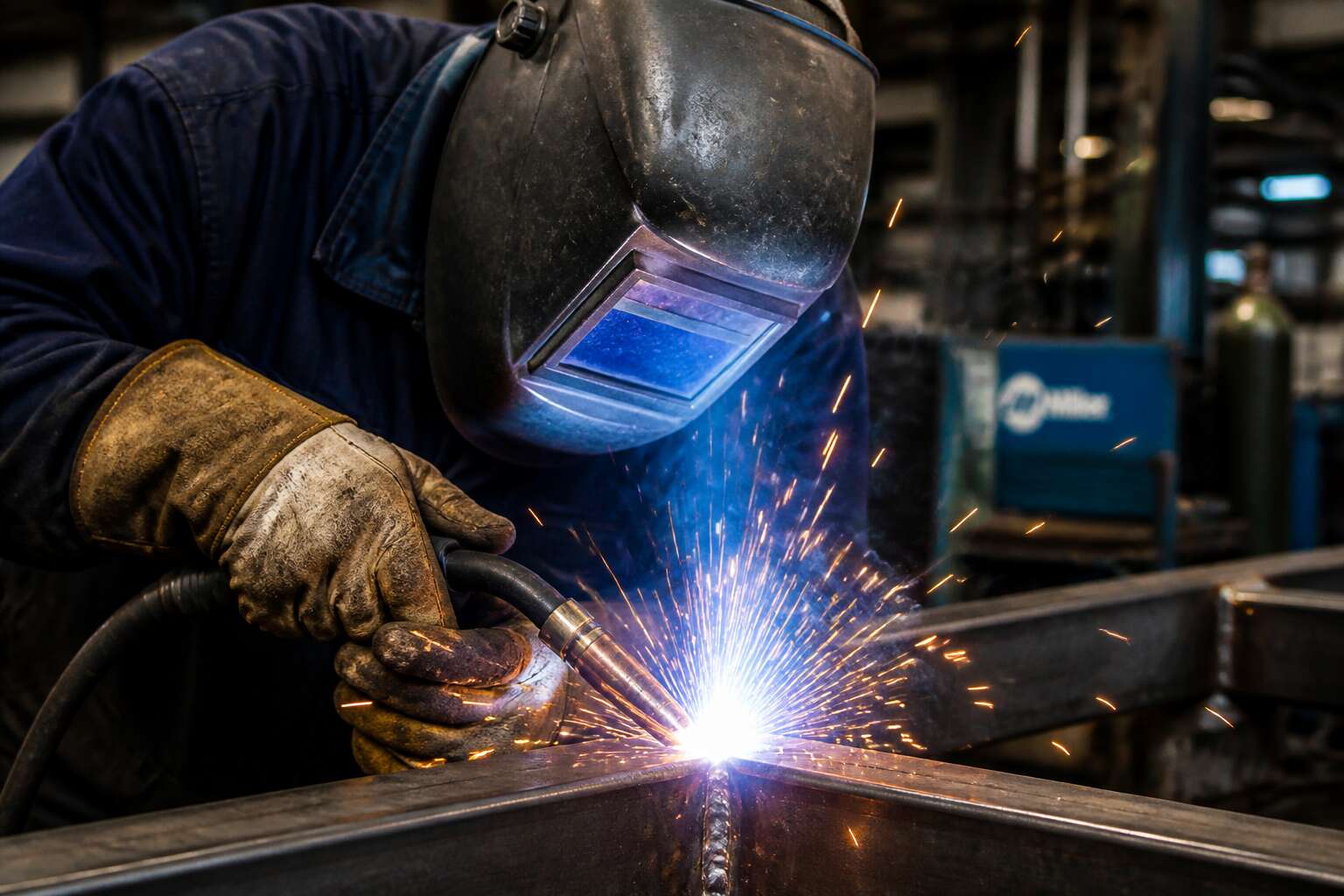
Cutting and welding are the two actions that separate fabrication from mere assembly. A CNC laser slices through 10 mm plate in minutes, but a rushed cut leaves a heat-affected zone that cracks under load. That tradeoff defines quality on the floor. For anyone watching the sparks fly, this is for fabrication meaning made visible.
Each join starts with a cut, and each cut sets the stage for the weld. The methods are not interchangeable:
- Plasma cutting handles thick steel but produces a wider kerf.
- Waterjet cutting uses no heat, preserving the original metal properties.
- Shearing is fast and cheap for straight lines on sheet metal.
Welding then decides whether the piece holds. TIG wins on thin stainless, MIG on heavier carbon steel. Get the combination wrong, and the part fails quietly, months later. That is the real cost of ignoring the basics.
Additive Fabrication (3D Printing)
Layer by layer, a component rises from a bed of powder. No chips fly, no coolant runs, and no cutting tool wears down. That is additive fabrication in its purest form, and it reframes for fabrication meaning from subtraction to addition.
In my experience, the real advantage shows in geometries no tool can reach. A fuel nozzle with internal curves, a bracket with variable density, a surgical guide matched to one patient’s scan. Traditional methods demand tooling and fixtures. This process asks only for a digital model.
For the South African shop, the implications are practical:
– Short run spares without waiting on overseas suppliers
– Design iterations in days instead of months
– Material waste slashed compared to machining from billet
But speed comes with limits. Build rates are slow, and the powder itself costs more than plate stock. Additive pays off on complex geometries, while simple shapes remain cheaper by traditional means.
Fabrication in Different Industries
Construction and Structural Steel
For fabrication meaning, start at a South African construction site. Structural steel arrives as raw sections, and the fabrication shop transforms them into the precise components that become office towers, warehouses, and bridge spans. Workers cut, drill, and preassemble steel members before anything reaches the site. This offsite preparation shapes whether a construction project stays on schedule.
What separates construction fabrication from other sectors is tolerance. A bracket misaligned by a millimetre causes bolted connections to fail during erection. The workflow therefore follows strict control:
- Drawing review before any cutting.
- Material traceability for every beam.
- Trial assembly in the workshop.
- Controlled welding sequences to prevent distortion.
When a contractor asks for fabrication meaning in this industry, they are asking about this entire system of tolerances and checks. It is the difference between a frame that survives fifty Highveld summers and one that buckles within five.
Automotive and Aerospace Fabrication
Ask an automotive engineer for fabrication meaning and you get a story about stamping presses, robotic weld lines, and cycle times measured in seconds! A million chassis frames leave the line with identical dimensions.
I have worked in both sectors. Aerospace operates under different rules. A turbine blade must survive thermal loads that reduce lesser metals to slag. Its fabrication relies on single crystal casting and five axis machining, with every ingot traced to its source.
The differences run deeper than tolerance specs:
- Automotive fabrication values speed and repeatability across high volume runs.
- Aerospace fabrication values material integrity and certification for each component.
Both sectors convert raw feedstock into shaped parts. The stakes differ. Automotive serves consumer replacement cycles. Aerospace serves flight safety, where a hidden flaw ends in catastrophic failure.
Electronics and Semiconductor Fabrication
Electronics and semiconductor fabrication shifts the sense of for fabrication meaning down to the scale of atoms. In a chip fab, the enemy is not heat or vibration but simple dust. A single wandering particle can destroy a silicon wafer worth thousands of rands. Workers wear cleanroom suits that make them look like clumsy astronauts, despite their precise work with photolithography and ion implantation.
This is fabrication as architecture. Each layer of circuitry demands absolute accuracy; a human hair is a catastrophic obstruction. The industry in South Africa remains small, but its cleanrooms operate under the same global rules. Silicon, after all, has no patience for local custom.
Art and Architectural Fabrication
From the sterile, atomic scale of chip fabs, we land in the noisy, physical world of art and architectural fabrication. I once watched a welder in Johannesburg shape a monumental steel sculpture with an attitude bordering on the divine. This shifts the understanding of what counts for fabrication meaning to include a dialogue between strength and precision.
Architectural work requires interpreting drawings from visionaries often removed from the physical demands of bending a beam. The foreman negotiates between intent and gravity, and the tasks demand:
- Precision cutting for structural connections.
- CNC bending for complex geometries.
- Manual welding for bespoke finishes.
Art fabrication adds whimsy! The artist signs the work, but the fabricator fixes the mistakes. Turning a fleeting vision into a permanent object is a form of translation. Neither realm tolerates sloppiness, yet both celebrate the human hand’s intervention.
The Deceptive Side: Fabrication as Falsehood
Fabrication in Media and Journalism
In 2011, the News of the World scandal exposed how fabricated reporting can destroy a respected publication. Journalists invented stories and intercepted private communications, and the resulting outcry closed the paper within days. For readers, the revelation was staggering!
Fabrication operates through several deceptive practices. Reporters might invent anonymous sources, manufacture quotes, or fabricate entire events to make a story more compelling. Each transgression deepens the damage. We only need to examine the fallout when South African media credibility is questioned.
- Public trust in reporting collapses
- Advertisers withdraw financial support
- Subjects of false stories suffer lasting harm
Digging into the for fabrication meaning reveals this darker dimension. Fabrication in journalism is a deliberate distortion. It transforms an institution meant to inform into a vehicle for misinformation, weakening democratic accountability.
Legal Implications of Fabricating Evidence
Fabricating evidence is a serious offence in South African law. The legal system depends on truthful testimony, and false evidence undermines the very foundation of justice. When someone manufactures documents or coerces witnesses, they commit perjury and obstruction of justice.
The consequences for offenders are severe:
- Criminal charges and possible imprisonment
- Automatic dismissal of the affected case
- Financial damages awarded to wronged parties
Prosecutors search for fabrication meaning when examining suspicious evidence. Courts have handed down lengthy sentences for manipulating judicial outcomes. The integrity of legal proceedings requires that evidence remains authentic and verifiable. Fabrication in this sphere destroys public confidence in court decisions.
Distinguishing Fabrication from Lying and Hoax
The search for fabrication meaning shifts when we move from workshops to words. A lie is a knowing falsehood, but fabrication is something more deliberate. It is an invented reality, carefully assembled to replace what actually happened.
Consider the difference. A liar twists the truth. A hoaxer builds an entire theatre of deception, complete with props and actors. Fabrication, the quietest of the three, presents falsehood as record. It does not announce itself.
In South African media, fabricated quotes have ended careers. The danger lies in persistence. A lie fades when exposed, while a fabricated document can survive for decades.
Those searching for fabrication meaning in courtrooms, newsrooms or family disputes are looking for a story so well constructed that it outlives the truth itself. The difference matters because a lie expires quickly, while fabrication leaves a permanent record.
How to Detect Fabricated Information
When a fabricated quote appears in a reputable newspaper, the first instinct is to trust the source. But in South Africa, where media accountability is under constant scrutiny, I see the ability to verify authenticity as a necessary skill.
Detection begins with simple questions. Who benefits from this claim? Does the language match the speaker’s known vocabulary? Cross referencing against original recordings or documented statements often exposes inconsistencies. A fabricated detail usually lacks the texture of lived experience.
- Check the date and context of the supposed origin.
- Search for corroborating sources beyond the original.
- Examine metadata in digital documents.
Understanding the for fabrication meaning is not enough. The deception lies in how plausibly a falsehood fits into an existing story. Once you learn to spot the inconsistencies, the record becomes less convincing.
Best Practices and Quality Control in Fabrication
Design for Fabrication (DFM)
Every fabrication shop knows the cost of a drawing that appears perfect but causes delays. Design for fabrication meaning, at its core, is the discipline of preventing that delay before it starts. Best practitioners place quality control at the design stage, not the inspection table.
I have seen failures from holes placed too close to bend lines. Begin with tolerance budgets that match real cutting and bending. Verify that each bend radius respects the material’s grain. For assemblies, plan weld access and heat distortion early, then confirm critical dimensions at three stages: incoming material, mid-process, and final fit-up.
A practical checklist for fabrication meaning includes:
- Confirm minimum wall thickness for plasma or laser cutting
- Check hole spacing relative to edges
- Align bend lines with fastener locations
- Specify surface finish only where function demands it
This clarity reduces rework and preserves the fabrication meaning of a component: one that arrives, fits, and performs.
Precision and Tolerances
A single oversized hole can scrap a 2-metre assembly. Precision in fabrication is not an accident. It is a chain of decisions. A tolerance budget that ignores the real behaviour of a cutting torch or press brake will fail. South African workshops see this daily, especially when plate from different suppliers varies in flatness.
Quality control shifts the fabrication meaning of a part when you measure at the right moments. Dimensional checks after cutting mean nothing if the weld later pulls the assembly out of square. Measure the material before it enters the line, verify after each critical operation, and confirm the final fit-up with a calibrated gauge. That sequence matters for fabrication meaning in any serious shop.
- Set tolerances relative to functional requirements
- Confirm datum features before machining
- Inspect the first piece
Numbers alone do not hold tolerances. People do! A skilled fitter reads a part differently from a novice, and that judgement is what counts for fabrication meaning.
Materials Selection
Material selection is where the real battle for fabrication meaning is decided. A workshop can hold perfect tolerances and still fail if the steel arrives with hidden laminations or the aluminium is a different temper than ordered. The cheapest quote for raw plate is often the most expensive mistake.
South African stockists vary in what they call prime material. Ask for the mill certificate. Check the batch number against the physical goods, because paperwork sometimes travels faster than quality. Consider these checks before any cutting begins:
- Verify thickness with a micrometer, not the sticker.
- Confirm the grade with a portable spectrometer for critical applications.
- Inspect for surface defects that will ruin a welded finish.
These steps take minutes but protect the entire project. The specification sheet says what should be. The material in your yard is what is. Verifying that difference is what separates fabrication meaning from a paperwork exercise.
Safety Protocols
Every factory floor holds a quiet tension. The grinder spins at eleven thousand revolutions per minute, and the operator’s hands are the only boundary between precision and tragedy. South African safety protocols are not mere paperwork. They form the existential commitment we make with steel. I have seen a certified welder skip a lockout procedure and lose three fingers to a press brake. That moment defines for fabrication meaning more than any tolerance chart.
- Isolate energy sources before any die change.
- Confirm gas lines are purged before ignition.
- Verify PPE fit, not merely presence.
These protocols are simple, yet we abandon them under deadline pressure. The human cost of a skipped step is permanent, while the schedule slip lasts a day. Safety is non-negotiable.
Quality Assurance and Inspection
For fabrication meaning to be complete, quality control must be rigorous. In South African workshops, inspectors trust calibrated instruments over intuition. A micrometre reading separates a critical component from a failed assembly.
Best practices begin with documentation. Every weld, every bend, every cut carries traceability. Inspection layers protect the final product. Visual checks catch surface flaws. Dimensional checks verify geometry. Non-destructive testing reveals hidden cracks.
Verification must happen at each stage:
- Raw material certification before cutting
- First-article inspection after setup
- In-process checks during production
- Final acceptance testing before delivery
The inspector acts as the final check. Tolerances are promises. Quality assurance keeps those promises.
Cost Estimation and Optimization
The real expense in fabrication often hides in what you cannot see. A flawed estimate can silently erode profit margins. In South Africa, where material costs shift with global markets, accurate pricing separates sustainable workshops from those that fail. For fabrication meaning to hold value, cost control must begin before the first cut.
Estimation requires discipline. A good fabricator knows that labour, machine hours, and material waste all carry hidden weight. Optimising cost does not mean choosing the cheapest steel or the fastest welder. It means understanding where value leaks.
Consider the stages that demand scrutiny:
1. Raw material purchase and transport logistics
2. Machine setup and changeover times
3. Welding consumables and gas usage
4. Rework and scrap allowances
5. Inspection and certification overheads
Each item carries its own variables. When estimators ignore these, fabrication meaning collapses into guesswork. Optimisation thrives on precise data. Track every hour, every metre of wire, every kilowatt of power. Those numbers inform better quotes and sharper production planning.
There is also the human element. Experienced hands cost more but waste less. A skilled boilermaker reads the metal’s behaviour and avoids costly mistakes. That judgement deserves a place in any cost model. For fabrication meaning to truly benefit a business, price must reflect reality. Low quotes win jobs but destroy shops. Accurate pricing, grounded in observation and history, builds repeat clients and steady growth.

0 Comments