Understanding the Role of a Steel Fabrication Facility
Core Processes in Structural Steel Production
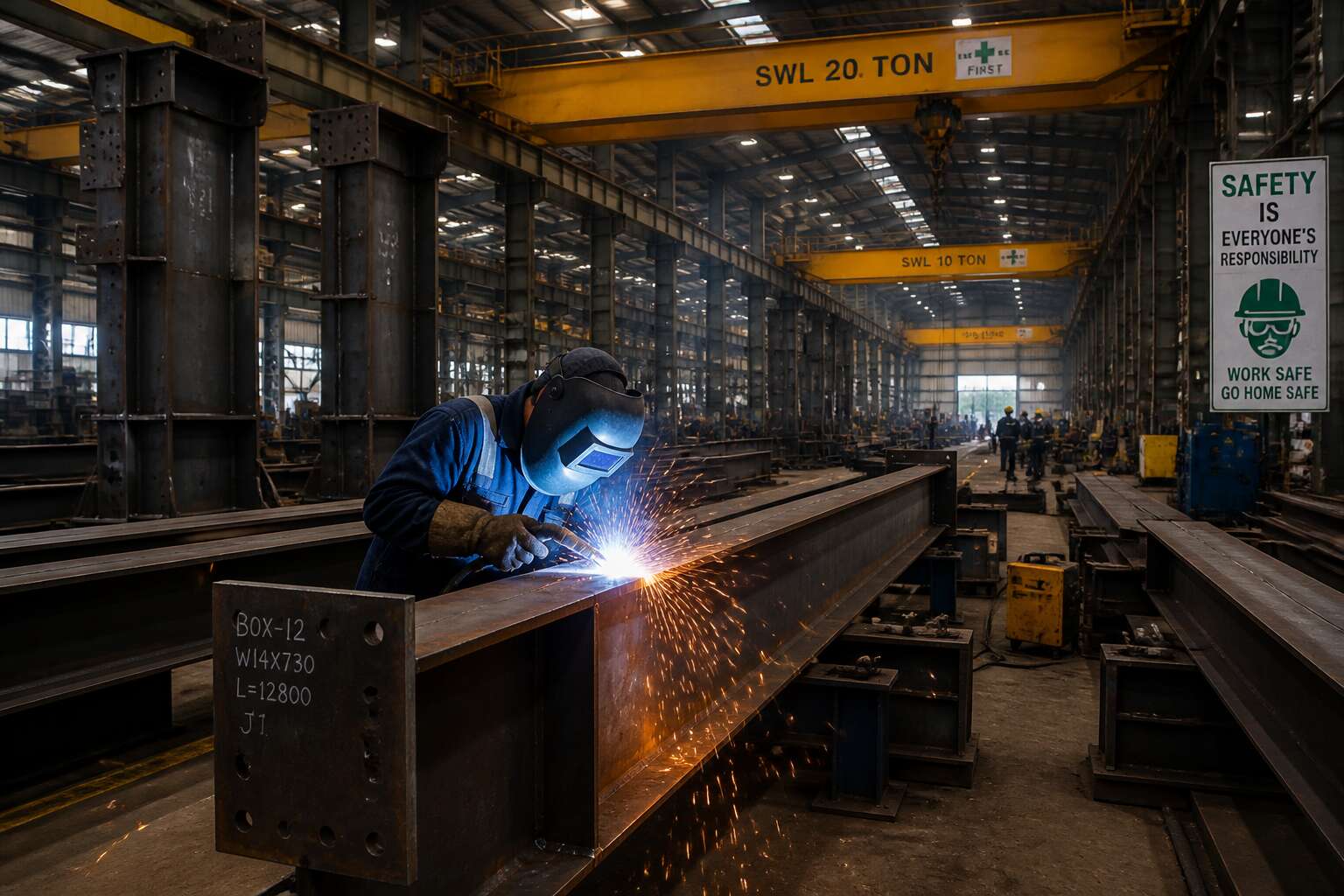
One ton of structural steel passes through dozens of hands before it supports a single roof. That journey starts inside a steel structure fabrication factory, where raw beams and plates are cut, drilled, welded, and treated with precision. The core processes decide whether a component withstands decades of South African weather or fails within years. Tolerances are measured in millimetres, and one misaligned weld can compromise an entire frame! The workflow follows a strict order:
- Shop drawings are checked against engineering specifications.
- CNC cutting beds profile each section to exact dimensions.
- Welders assemble components in jigs that lock geometry in place.
- Surface blasting removes scale and oxidation before primer application.
Each step demands a different skill set. All of them revolve around one constant: accuracy. When the final component leaves the floor, it carries the accumulated decisions of every operator who touched it.
Essential Equipment and Machinery
One misplaced hole can stall an entire site for a week. That is why a steel structure fabrication factory leans on equipment built for absolute repeatability! The role of this facility extends beyond shaping metal. It coordinates material flow, jig alignment, and final inspection under one roof.
Consider the essential machinery:
- CNC beam lines that drill and cut in a single pass.
- Hydraulic plate bending machines for curves that stay true.
- Overhead gantry cranes that move 20 ton sections without flexing.
Each machine passes work to the next. A magnetic crane lifts raw plate onto a marking table, while automated tack welders hold geometry before full welds. Inside a steel structure fabrication factory, the floor becomes a controlled environment where dust, humidity, and temperature are managed. This machinery does not create quality by itself. It simply removes the variables that cause human error.
The Importance of Skilled Workforce
At a steel structure fabrication factory, the value of skilled hands often hides behind the glow of automated torches. Yet I have watched a veteran fitter correct a misalignment that a laser scanner missed. That is the real work: interpreting tolerance charts, anticipating weld distortion, and doing it before the crane moves the next section.
A capable workforce does not simply follow instructions. They translate engineering intent into reality. In South Africa, a steel structure fabrication factory that invests in apprenticeship pipelines sees fewer rejected seams and safer lifting practices. A good team knows when to slow down!
The men and women who read blueprints, set up jigs, and inspect final welds carry the experience machines cannot encode. Their judgement matters most when a client spec conflicts with a physical constraint. The line between a finished portal frame and a collapsed bogey marks the difference between qualified and unqualified workers.
How to Choose a Reliable Steel Fabrication Partner
Assessing Production Capacity and Capabilities
Nearly 40% of construction delays in South Africa stem from fabrication partners who overpromise capacity. When you choose a steel structure fabrication factory, look past the floor space and count what leaves the loading bay each week.
A reliable partner will share their order book openly. Ask how many tons they currently have under production and how many shifts they run! A steel structure fabrication factory that cannot answer those numbers clearly is already at risk of missing your deadline.
Their capabilities should be verified, not assumed. Confirm details like:
- certified quality management systems
- a documented schedule for maintenance shutdowns
- access to local steel suppliers
I have learned that production capacity is not about machines alone; it is about honest forecasting and spare time reserved for changes.
Project Management and Communication Efficiency
The difference between a reliable steel structure fabrication factory and one that drifts into delays often comes down to communication rhythms. Weekly progress meetings with named decision makers prevent the slow erosion of timelines. A single unapproved drawing revision can stall production for days, and the cost of that silence is measured in lost site days.
The best fabrication partners assign one project coordinator to your build. That person becomes the sole conduit for revisions, delivery dates, and site queries. Their reporting cadence is fixed and predictable. When problems arise, they arrive with options, not just alerts.
Strong project management in this industry typically includes:
- a documented communication protocol with response times
- a shared live schedule that tracks every fabrication milestone
- a structured change order process with cost implications stated upfront
South African projects fail when communication is scattered across email threads and WhatsApp groups. Protect your programme by choosing a steel structure fabrication factory that treats communication as a deliverable in its own right.
Transparent Costing and Contract Terms
Some quotes arrive with a price so low it feels like a gift. It isn’t. Choosing a steel structure fabrication factory without a forensic look at the contract is how budgets vanish. The cheapest number often excludes shop drawings, blast marking, or bolt sets. You discover these omissions only after signing.
Transparent costing means the steel structure fabrication factory itemises every line. It separates materials from labour, transport from site handling, and it states payment milestones clearly. Your contract should also define what happens when the exchange rate shifts or steel prices spike. South African suppliers who avoid these clauses are not protecting you.
A reliable partner will also list:
- the exact scope of supply
- the revision approval process
- the dispute resolution route
That list of details, written plainly, is worth more than a discount!
Client References and Past Project Reviews
References are the unvarnished truth. A steel structure fabrication factory can present flawless brochures, but past clients reveal the actual experience. Ask for direct contact with project owners, not just managers. Visit completed sites if possible. Look for patterns:
- Repeat business from the same clients
- Projects completed under budget stress
- Complaints resolved without litigation
One major South African developer told me that the real test was how the factory handled site errors. Everyone makes mistakes. The reliable partners own them quickly and fix them without drama. That behaviour appears in reviews only if you ask pointed questions. Every reference check should include a question about communication during crisis. What actually happened when the timeline slipped? The answers reveal more than any portfolio. A steel structure fabrication factory earns trust through the messy moments, not the photo opportunities.
The Fabrication Workflow: From Design to Installation
Engineering and Structural Detailing
A single rolled steel I beam can trace its origin to a thousand decisions made long before the first torch is lit. The journey from a conceptual sketch to a standing frame is a testament to precision and patience. It begins with the design engineer, who translates architectural intent into a structural skeleton. This is where load paths are calculated and member sizes are selected. The process demands a clear understanding of how the structure will behave under stress, wind, and gravity.
The next stage is structural detailing, a discipline that bridges the gap between abstract mathematics and physical reality. Detailers create the exact drawings that guide every cut, hole, and weld. These drawings are the single source of truth for the workshop. A small error here can lead to costly rework on site, so the work is painstaking. The best detailers think in three dimensions, anticipating how pieces will fit together long before they arrive on the truck.
This transition from the digital model to the physical workpiece requires careful planning. The fabrication workflow is not a single action but a series of coordinated steps. Before production begins, the factory must finalize several critical elements:
– Material sourcing and quality verification
– CNC programming for cutting and drilling
– Welding procedure specifications for each joint type
– Sequence planning to align with the installation schedule
Each of these steps ensures the steel structure fabrication factory operates with minimal delays. Modern detailing software flags clashes and conflicts before steel is ever cut, but it cannot replace the judgement of an experienced project team. The true test comes when the fabricated members arrive on site and the bolts align perfectly with the embedded plates. That moment of silent, perfect fit is the ultimate measure of a workflow built on clarity and discipline. The installation crew then takes over, relying on the shop drawings as their map to raise the frame into the sky.
Material Sourcing and Inventory Management
Anyone who thinks a steel structure fabrication factory runs on brute force has never watched a warehouse manager chase a missing beam section. The real muscle is material sourcing and inventory management. Steel does not arrive by magic. It comes from local mills or from ports, often with lead times that test human patience. Procurement teams chase quotes while production waits. Trust me, that is not a fun place to be.
Good factories keep a careful buffer. They track every plate, column and bracket. A shortage stops the entire line. Excess stock ties up cash that could fund better equipment. It is a delicate balance. If you cannot locate the right I-beam section, the schedule slips and the client grows restless.
Most reliable operations run a simple system:
- Order steel early using production schedules
- Verify mill certificates before accepting delivery
- Store materials by project to prevent mix-ups
- Reconcile stock levels weekly against cutting lists
That mundane discipline separates a professional steel structure fabrication factory from a scrap yard with high hopes.
Cutting, Forming, and Welding Operations
The digital blueprint is only the beginning. The real work happens when that design meets raw steel on the factory floor. A steel structure fabrication factory translates 3D models into physical components through a sequence of controlled operations, each one demanding precision. The first step is cutting, where CNC plasma tables and saws slice through beams and plates. These machines follow the digital nest, which is the layout that minimizes waste. A good nest can save a project thousands of rands in material costs.
Once the pieces are cut, they move to the forming stage. This is where steel gets its shape through processes like bending and drilling. Press brakes apply tons of force to create the correct angles for connections. Drill lines punch holes with exact spacing. Any deviation here creates problems during erection on site. The sequence is critical.
From there, the components go to the welding stations. Welders join the pieces together using procedures that have been prequalified. The order of operations matters. Welders need clear access to the joints, so subassemblies are built in a specific sequence.
1. Fit up the main members using clamps and drift pins.
2. Tack weld the assembly to hold it in place.
3. Complete the full welds in a sequence that controls distortion.
4. Allow the assembly to cool before grinding and finishing.
Each weld is inspected, either visually or with ultrasonic testing for critical connections. The result is a finished component, marked and ready for delivery. It is a linear process, but every step is verified. That is what separates a reliable steel structure fabrication factory from a simple metal shop. The workflow is built on the idea that errors are caught on the floor, not in the field.
Surface Preparation and Protective Coating
Corrosion costs South Africa billions of rands annually. A reliable steel structure fabrication factory treats protective coating as a critical shield. Before paint, abrasive blasting removes mill scale and rust, creating a rough profile for adhesion. Without this step, coatings fail quickly.
The coating follows in controlled layers. Welders have finished, so the component is clean and ready for the spray booth.
- Blast to standard Sa 2.5.
- Remove dust with vacuum equipment.
- Apply primer within a couple of hours.
- Add intermediate and top coats.
- Check dry film thickness.
Humidity and dew point are monitored throughout. The finished component ships with a durable shield, ready for harsh South African weather.
Quality Inspection and Testing Procedures
From the initial design model to the final erection on site, a steel structure fabrication factory follows a defined workflow. Every component moves through inspection gates rather than flowing straight to dispatch.
A typical quality procedure covers these steps:
1. Dimensional checks after cutting and again after welding.
2. Visual weld inspections carried out by certified inspectors.
3. Non destructive testing at critical connections.
4. Traceability checks that link material certificates to each member.
Once the paperwork matches the physical part, the structure is released for delivery. The installation crew ends up with components that align, and the connection details behave exactly as the designer intended. Rework stays low because problems are caught inside the shop, not on site.
Transportation and On-Site Assembly
Christopher Wren said architecture needs soundness, commodity, and delight. Structural steel logistics demand the same care. A steel structure fabrication factory coordinates more than welding and coating. It plans how members travel from shop floor to final position.
The workflow starts by splitting shop drawings into erection sequences. Each sequence sets the order for fabrication, loading, transport, and site handling. This prevents bottlenecks before the first truck arrives.
Follow a typical order:
- Columns and beams are batched by zone.
- Loading follows the erection sequence.
- Truck departures are timed to crane availability.
Delivery schedules come from the steel structure fabrication factory’s production plan. The erection crew receives components in the exact order needed. That means no rehandling, no lost pieces, and no idle cranes. The structure goes together as smoothly as the model predicted.
Innovations and Trends in Structural Steel Manufacturing
Automation and Robotic Welding Systems
In the conservative world of structural steel, admitting a robot might weld better than you is the new corporate confession. Nearly 40% of new installations in modern facilities now involve some level of automated assistance. A steel structure fabrication factory that ignores this shift is essentially bringing a butter knife to a laser fight.
The real revolution isn’t about replacing the human touch, but about augmenting it with relentless precision. Robotic welding systems now handle the monotonous, high-volume seams that used to test a welder’s patience and eyesight. These machines deliver a consistency that manual effort, however skilled, simply cannot match over a ten-hour shift. This trend also addresses a chronic shortage of qualified welders, allowing the skilled workforce you already possess to focus on complex joints and critical inspections.
We are seeing the rise of cobots, which are collaborative robots designed to work alongside humans without the need for extensive safety cages. This integration allows for a hybrid workflow where the machine does the heavy lifting and the human handles the oversight. Furthermore, software integration is becoming the true differentiator where automation data feeds directly into quality control systems, flagging anomalies in real time. This data-driven approach reduces waste and rework. The typical automated systems now found in a modern factory include:
– Robotic plasma cutters for intricate plate profiles
– Automated tack welding stations for assembly preparation
– CNC drilling lines for precise bolt hole placement
– Conveyor systems that move components between robotic cells
When scouting for a partner, the presence of these systems is a strong indicator of a factory’s commitment to efficiency and schedule adherence. It affects the bottom line directly, as faster turnaround times on fabrication usually translate to better pricing for you. Automation is not just a fancy add-on; it is the operational backbone that allows a steel structure fabrication factory to remain competitive in a demanding market.
Sustainable Production and Material Recycling
Recycled steel now makes up a growing share of raw materials in South African projects, yet many procurement decisions still overlook this trend. A steel structure fabrication factory that commits to sustainable production reduces waste and energy consumption. Melting scrap requires far less electricity than refining virgin ore, and modern electric arc furnaces make this process economically viable. Closed-loop water systems further lower environmental strain.
Production offcuts and slag are no longer treated as useless leftovers. Facilities sort scrap by grade, sell slag for construction aggregate, and reuse small pieces for custom brackets. We see these practices shorten supply chains and stabilize material costs. For example:
- Scrap steel is graded and baled on site
- Slag is crushed and sold to road builders
- Offcuts are repurposed for supports and shims
Sustainable methods directly affect your project timeline, since efficient recycling prevents material shortages and reduces the risk of fabrication delays.
Building Information Modeling (BIM) Integration
The steel structure fabrication factory of tomorrow plans its cuts before the first flame is lit. Building Information Modeling Integration has shifted the trade from drawing boards to digital twins. A welder now works from a model that updates in the field, not a static PDF that cannot speak back.
This software catches interferences before they become costly mistakes. It gives every bolt a coordinate and every beam a scheduled birth. For South African sites, especially those in remote areas, this preplanning reduces the risk of sending a truck across the Karoo with the wrong part.
A modern facility uses these models to choreograph the flow of materials and labour. The detailing phase, previously a bottleneck of manual checks, now outputs directly to CNC machines. The result is a fabrication process where the data drives the crane. Engineers and clients gain visibility into the structure’s innards, which builds trust long before the steel stands in the veld.
Common Challenges and Solutions in Steel Fabrication
Meeting Tight Project Deadlines
Tight deadlines test every part of a steel structure fabrication factory. When work slips by a few days, costs grow across the supply chain. The most common challenge is late raw material. A mill that misses its slot idles the cutting crews. The solution is to keep buffer stock for high-use sections like columns and beams.
Another obstacle is rework from drawing changes. Each revision interrupts production flow and eats into the schedule. Good factories use a freeze point. After that date, no changes are accepted without a new timeline. We also track every hour of welding and assembly work in a live system.
For urgent jobs, we use these steps:
- Move the job to a dedicated line.
- Run two shifts with the same crew.
- Confirm the transport booking before the first weld.
A steel structure fabrication factory that plans for these delays finishes on time more often.
Handling Complex Structural Designs
Most fabrication errors trace back to a single missing check. Complex structural designs push a steel structure fabrication factory past its comfort zone. Curved members, heavy plate girders and tight tolerances test the crew differently. A common failure is assuming the drawing is buildable. It looks fine on screen, but the real section might clash with a connection plate.
We solve this by checking every node before cutting starts. The detailing team and workshop floor meet over the model. They agree on weld access, bolt clearance and lifting points. This removes most problems.
- Confirm steel grade and plate thickness for each member
- Check whether welding distortion will push dimensions out of spec
- Plan the erection sequence early to match site needs
A steel structure fabrication factory that sequences work to the erection plan avoids last-minute site changes.
Ensuring Consistent Weld Integrity
A weld can look flawless and still fail six months later. In a steel structure fabrication factory, consistent weld integrity comes down to the details that are easy to skip under deadline pressure.
One common challenge is variation between operators. Two welders running the same joint with different heat inputs produce one sound seam and one with hidden porosity. We solve this by locking procedure parameters before production starts. Each workstation follows the same amperage, travel speed, and wire feed settings. This keeps every pass consistent, even when the crew changes shifts.
Another issue is distortion during multi-pass welding. Long fillet welds pull the steel as they cool, and a connection plate can shift out of spec. The team uses jigs and tack welding sequences to hold geometry, then signs off between passes while correction is still cheap. In any steel structure fabrication factory, catching that drift early is what separates a clean assembly from a forced fit on site.
Reducing Waste and Environmental Footprint
In a steel fabrication workshop, waste is rarely visible in the moment. Offcuts pile up quietly. Energy burns through unplanned rework. The environmental footprint grows from decisions made before production begins.
Material planning cuts this at the source. Nesting software packs more parts into fewer plates, but the real gain comes from aligning orders with actual cutting lists. Over-ordering by a single beam profile can leave tonnes of unused stock. We track scrap rates per job to find patterns.
- Reusable offcuts sorted into grade-specific bins.
- Coating materials checked for expiration before mixing.
Scheduling similar thicknesses together reduces machine changeover waste. A steel structure fabrication factory lowers its footprint without slowing output when these practices become routine.

0 Comments