Core Competencies in Metalworking Education
Blueprint Reading and Geometric Dimensioning
Blueprint reading demands precision, and geometric dimensioning and tolerancing (GD&T) supplies the formal system. Without fluency in these symbols, a machinist cannot work reliably. In South African shops, misread drawings cost materials and erode client trust. I have seen fabrication training that skips this foundation produce workers who can cut and join metal, yet cannot interpret quality specifications.
Reading a drawing requires understanding projection methods, section views, and dimensioning conventions. GD&T adds true position, flatness, and perpendicularity. These tell the machinist how parts fit in real assemblies. Competent fabricators check the title block first, then the notes, then the geometry.
Master these competencies:
- Interpret weld symbols and callouts
- Identify datum references on castings
- Convert inch and metric tolerances correctly
- Visualise finished parts from orthographic views
Those skills separate certificate holders from people who actually deliver. The best fabrication training tests blueprint reading and GD&T against real workshop drawings.
Welding Processes and Applications
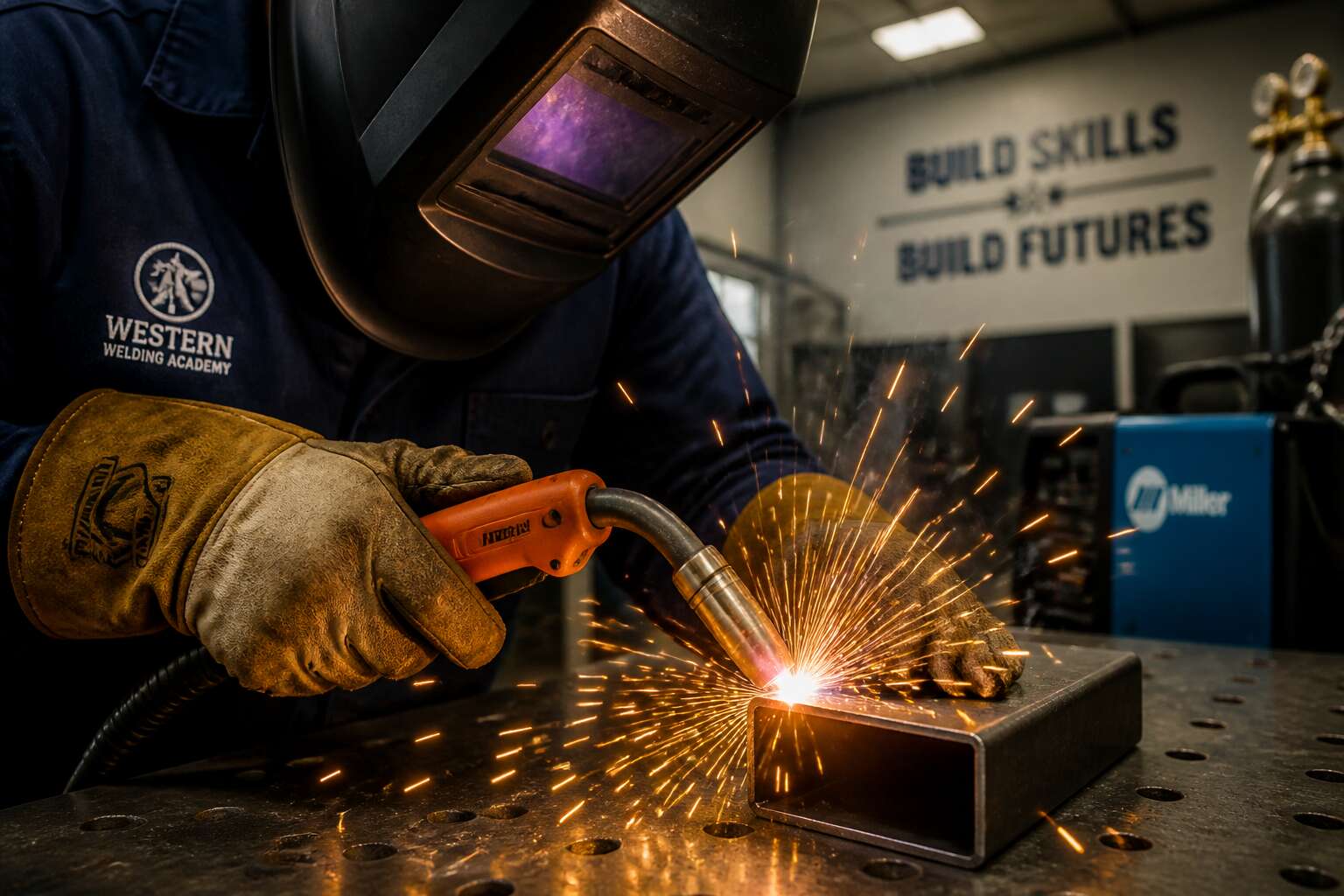
The welding bay is where fabrication training proves itself. A student who can read a drawing but cannot lay a sound bead is still an apprentice in the truest sense. Welding processes are the physical application of all that theoretical knowledge, demanding a steady hand and an understanding of metallurgy that no textbook can fully convey.
– Shielded metal arc welding (SMAW) for structural steel and site work
– Gas metal arc welding (GMAW) for higher deposition rates in production
– Gas tungsten arc welding (GTAW) for critical piping and thin-gauge materials
– Flux-cored arc welding (FCAW) for outdoor conditions where wind disrupts shielding gas
South African industry relies heavily on these core methods, from mining infrastructure to agricultural equipment. A fabrication training programme must move beyond machine operation into the realm of joint design, preheat requirements, and distortion control. The real learning happens when a welder understands why a weld cracks, not just how to grind it out. That deeper comprehension of heat input and cooling rates is what separates a technician from a button pusher.
Competent welders also recognise that process selection is a business decision. Choosing the right method affects speed, consumable costs, and rework rates. Fabrication training that treats welding as a problem-solving exercise, rather than a series of exercises, produces people who add value from their first day on the shop floor.
Precision Measurement and Quality Control
In fabrication, a half millimetre of error can turn a design into expensive rework. Precision measurement is the quiet discipline that holds everything together, and fabrication training must treat it as a core competency. South African metalworkers know that quality control starts at the workbench, not final inspection.
Trainees learn to use micrometers, height gauges, and digital callipers with confidence. They practice measuring at different temperatures and on varying material thicknesses. This builds awareness of thermal expansion and surface defects. These skills are vital for maintaining tolerances in structural work.
Fabrication training should also introduce documenting measurements. Consistent records reveal patterns that prevent failures and feed into quality control systems.
- Interpret calibration certificates for measuring tools.
- Assess if a deviation is acceptable for the specified tolerance.
- Communicate nonconformities clearly to production staff.
These competencies reduce scrap, lower rework costs, and strengthen trust.
Safety Protocols and Workplace Compliance
Personal Protective Equipment Essentials
Every year, hundreds of avoidable injuries occur on South African shop floors because of poor protection. Safety protocols are the foundation of a sustainable career.
Understanding workplace compliance means recognising that Personal Protective Equipment (PPE) is your last defence, not your first. A welder’s helmet, leather gauntlets, and respirator only function when correctly fitted and maintained. Hearing protection shields against the din of grinding.
Essential gear includes:
- Steel-capped boots with puncture-resistant soles
- Impact-rated eye protection, clear or shaded
- Fire-retardant overalls covering all skin
- Respiratory masks for fume and dust
Each item must be inspected every shift. A cracked lens or frayed strap compromises the entire system. Fabrication training that drills these routines reduces risk and builds discipline. Compliance is a daily commitment to returning home whole.
Ventilation and Fume Extraction Systems
Hexavalent chromium and manganese oxide hang in the air long after the arc dies. They pass through standard filter masks and settle deep in lung tissue. Ventilation and fume extraction systems decide whether that dust remains a hazard or a controlled variable.
Local exhaust ventilation captures contaminants at the source. I have watched shops mount extraction arms metres from the work and then wonder why fumes linger. Compliance demands attention to:
- Capture velocity at every welding station
- Air changes per hour matched to shop size
- Filter replacement intervals aligned to production volume
Fabrication training that embeds these checks into daily routine builds the habit of reading airflow gauges. The best fabrication training also teaches apprentices to report weak extraction immediately. A compliant workshop is not a wall certificate. It is the pressure drop across a clean filter, recorded with the same care as a weld inspection.
Emergency Response and Fire Prevention
A spark lands in a bin of oily rags. Forty seconds later the workshop is gone. Emergency response is not a drill; it is the difference between contained incident and catastrophe. Fabrication training must treat fire prevention as a daily practice.
The first action after a fire begins is often the wrong one. Panic overrides procedure unless procedure has been rehearsed. Shops that run unannounced evacuation drills and extinguisher practice see fewer injuries. Compliance demands documentation, but documented plans do not hold up under smoke.
- Mark all exits and fire points with visible signage
- Assign a roll call officer for every shift
- Test extinguishers monthly, not yearly
Fabrication training that forces apprentices to stop work, isolate gas lines, and account for team members builds the discipline that saves lives. South African regulations require emergency plans, yet most failures are human. The response becomes automatic only through repetition.
OSHA Standards for Manufacturing Environments
Nearly three million workers die each year from work-related incidents. I have seen the guard removed for convenience, the chemical without a label, the switch that could not be locked out. OSHA standards for manufacturing environments exist because someone, somewhere, paid for a lesson with their body. These are not administrative details. They separate a worker going home from a worker being carried out.
Fabrication training must embed these protocols into routine. A trainee who inspects a grinder before use, verifies lockout procedures, and reads a safety data sheet without being told carries that discipline into every role. South African regulations demand compliance, but the spirit of the law protects people.
- Conduct weekly machine guarding inspections
- Document all lockout/tagout procedures
- Maintain hazard communication records
The audit measures what a workshop values. Fabrication training that treats compliance as a skill builds a workforce that understands why the rules exist.
Certification Pathways and Industry Credentials
American Welding Society Qualifications
In South Africa, the welding trade rewards proof of skill, and nowhere is that proof more potent than in the American Welding Society qualifications. Certified welders command higher rates and more consistent work, yet many fabrication training programs overlook the formal pathways to these credentials. I have seen capable hands fail to progress simply because they lacked the paperwork. The AWS offers a structured ladder. Consider these recognized certifications:
- Certified Welder, a performance based test for entry level competence.
- Certified Welding Inspector, which combines experience with a rigorous written exam.
- Senior Certified Welding Inspector, adding supervisory and documentation duties.
Each credential builds on the previous one, creating a clear trajectory. When you complete your training, you should know exactly which qualifications match your career goals. That clarity turns raw talent into marketable mastery!
National Institute for Metalworking Skills Certificates
Credential pathways in South African metalworking often neglect the National Institute for Metalworking Skills, despite NIMS carrying serious weight in global supply chains. NIMS certificates measure actual output. This includes machine setup, cut accuracy, and finished part tolerances. Such credentials serve fabrication training well because competence is verified on real equipment, not through written recall alone.
The system divides into clear practice areas, each demanding a hands-on performance assessment. Your workpieces are measured, logged, and compared against published national standards.
- CNC milling and turning operations
- Drill press and precision grinding
- Industrial technology maintenance
Each certificate stands alone, so you can stack them as your career deepens. For employers, NIMS creates a clean audit trail. For workers, it converts raw shop experience into portable, verifiable proof of skill.
Certified Manufacturing Technologist Programs
In South Africa’s fabrication shops, the Certified Manufacturing Technologist (CMfgT) credential sets apart a process thinker from a pure operator. It requires a written exam that tests applied knowledge across multiple disciplines, alongside documented industry experience. This is not a memory test.
The program covers production planning, quality assurance, and manufacturing processes. It forces candidates to understand why a procedure works, beyond simply performing it.
- Material selection
- Process improvement
- Cost estimation
For workers, this certification improves eligibility for supervisory roles. For employers, it signals capacity for systematic troubleshooting. That makes fabrication training programs wise to integrate CMfgT preparation, because the credential transfers across industries and borders.
Specialized Endorsements for Pipe and Structural Work
Specialized endorsements distinguish pipe and structural welders from general fabricators. In South Africa, the boilermaker trade certificate remains the baseline for structural work. Pipe fitters typically add a 6G closed butt weld endorsement, which requires practical assessment on pipe in the fixed position. These credentials demand demonstrated skill, not just classroom time.
Fabrication training programs aligned with SAQA registered unit standards give workers a clear path. The Southern African Institute of Steel Construction offers certifications for structural steel erectors. For pipe work, CSWIP endorsements hold recognition across borders. A welder who invests in fabrication training and earns both structural and pipe credentials becomes an asset on complex projects.
A typical progression might look like this:
- Trade certificate in boilermaking or pipefitting
- Position specific weld tests for pipe or structural joints
- Industry endorsement from SAISC or CSWIP
Recertification and Continuing Education Units
Certification is not a destination. It is a renewal cycle. In South Africa, a boilermaker trade certificate does not expire, but the industry endorsements that make a welder competitive do. CSWIP welder qualifications typically require revalidation every two years, while structural certifications from SAISC demand documented proof of continued competence.
Continuing education units, or CEUs, keep fabrication training relevant. They require welders to return to the workshop and learn updated procedures, new consumables, and changing standards. I have watched skilled welders lose contracts because their endorsements lapsed quietly. Fabrication training providers who understand this market schedule recertification sessions throughout the year, so no one has to wait for a single assessment window.
Consider what recertification demands:
- Renewed practical weld tests at certified facilities
- Evidence of ongoing welding activity within the validity period
- Updated theory modules covering new code revisions
Welders who respect this cycle keep working. Those who ignore it do not.
Advanced Equipment and Automation Skills
CNC Operation and Programming Basics
In modern fabrication training, CNC operation has become a core competency. I have watched operators transform their careers by mastering G-code. Programming basics are not optional extras. They are the language of automated production. An operator who can compose a clean program reduces wasted cycles and protects expensive tooling.
Start with absolute and incremental coordinates. Then explore canned cycles for drilling or threading. Every program includes a safety line, spindle speed, and feed rate. Dry runs verify logic before the cutter engages. What a relief that brings!
- Machine home and reference returns
- Tool radius compensation
- Work offset selection
Automation extends beyond the machine. Bar feeders, robotic arms, and integrated measurement stations all depend on predictable programming. Training that embraces these skills prepares workers for the realities of a connected workshop.
Robotic Work Cell Programming
The most efficient robotic cell still depends on a human who can think in coordinates. In advanced fabrication training, robotic work cell programming has moved from optional to essential. A robot follows every command literally, so a programmer who mistakes a Cartesian move for a joint move creates expensive scrap. Learners spend hours teaching points, defining tool center points, and testing logic. The workflow often mirrors a production changeover:
- Define the part reference frame.
- Teach the home and safe positions.
- Program motion paths with collision checks.
- Validate with a slow-speed dry run.
Each step reveals how sensors and actuators interact. When a robot feeds a press brake, the program must synchronize with the machine’s dwell time. South African manufacturers need this skill set now. Fabrication training that skips robotic programming leaves workers behind as factories adopt automated cells for repetitive bending and material handling.
Laser Cutting and Plasma Arc Technology
Laser cutting and plasma arc technology demand a different kind of attention. These tools cut through steel with a precision that rewards operators who understand focal length, gas pressure, and kerf width. In South African workshops, fabrication training now includes these systems because they handle complex geometries that manual methods cannot match.
- Setting pierce height and cut speed
- Selecting the correct nozzle for material thickness
- Reading dross formation to adjust parameters
Plasma arcs react to every variable, from air moisture to electrode wear. I have seen operators avoid costly rework simply by watching those signs. Training that covers this equipment builds confidence, and that confidence shows up in production times.
Metrology and Coordinate Measuring Machines
Metrology has shifted from a final inspection step to a central role on the production floor. Coordinate measuring machines trace complex geometries with a precision that manual tools cannot match, and South African workshops are paying attention. Fabrication training now includes these systems, teaching operators to program probe paths, interpret measurement reports, and catch drift before it becomes scrap.
A coordinate measuring machine rewards patience. I have watched operators save entire batches by trusting what the machine told them. The probe moves in deliberate arcs, collecting thousands of data points that reveal machine wear, tool deflection, and material behaviour. Operators who understand this equipment also learn to spot environmental variables, such as temperature swings and fixture pressure, that can skew results.
Fabrication training for CMM work covers calibration routines, probe selection for different material finishes, first article inspection, and verifying the machine before trusting the data. This knowledge turns a measurement instrument into a decision making tool.
Career Progression and Specialized Development
Apprenticeship and Mentorship Models
South Africa faces a documented scarcity of qualified artisans, with industry projections showing a gap of tens of thousands by 2030. Apprenticeship pathways within fabrication training provide a structured route from novice to certified professional.
Mentorship models pair you with seasoned artisans who assess your progress through practical tasks, not just theory. This hands-on development accelerates competence in real workshop conditions.
- Advance through helper, welder, and artisan grades.
- Gain exposure to code compliance and client specifications.
Specialized development then leads to supervisory roles, quality assurance positions, or entrepreneurial ventures in custom fabrication.
Lean Manufacturing and Process Improvement
South African manufacturers lose an estimated 18 percent of productive hours to process inefficiencies, a figure that demands attention. Career progression in this field now hinges on lean methodology. Your fabrication training becomes the raw material for diagnosing workflow interruptions, cutting costly rework, and refining every stage of production.
Specialised development pushes you beyond the workshop floor. You move from line operator to process analyst, then to continuous improvement lead. Each transition requires sharper analytical skills and a deeper grasp of waste elimination.
- Value stream mapping
- Kanban inventory systems
- Root cause analysis
- Kaizen event coordination
These tools reshape how you interpret production data and drive daily decisions. I have seen artisans with solid fabrication training earn supervisory roles by applying lean principles without waiting for permission.
Supervisory and Leadership Training
Supervisory roles demand more than technical mastery. Your fabrication training gives you the vocabulary, but leadership requires translating shop floor realities into team direction. I recall a welder who moved into chargehand after learning to delegate inspection tasks. That shift changed production flow.
- Conflict resolution during shift handovers
- Resource allocation across workstations
- Coaching artisans without micromanaging
Most importantly, these skills compound. Each supervisory milestone exposes you to production planning and safety accountability. In South Africa, manufacturers increasingly promote from within, yet only a third of artisans pursue formal leadership development. Those who do become the link between executive strategy and daily output.
Niche Skills for Aerospace and Automotive Sectors
The aerospace and automotive sectors demand a different kind of precision. Here, fabrication training evolves into niche specialisation, where tolerances shrink and material behaviour becomes a discipline in itself. I have watched artisans transition from general steelwork to aerospace alloys, where thermal expansion and grain structure dictate every pass.
Aerospace work rewards those who understand thin-gauge materials and controlled distortion. Automotive fabrication pushes toward high-strength steels and aluminium structures, often in crash-critical zones.
These roles require additional certifications and practical exposure:
– Aerospace: AS9100 awareness, NADCAP processes, specialised riveting and sealing
– Automotive: resistance spot welding, adhesive bonding, hot stamping qualifications
In South Africa, the OEM supply chain and defence industry create genuine pathways for this progression. Fabrication training becomes the foundation, but the specialisation decides your ceiling.

0 Comments