Understanding Industrial Mesh Materials
Metal Wire Cloth: Grades and Weaves
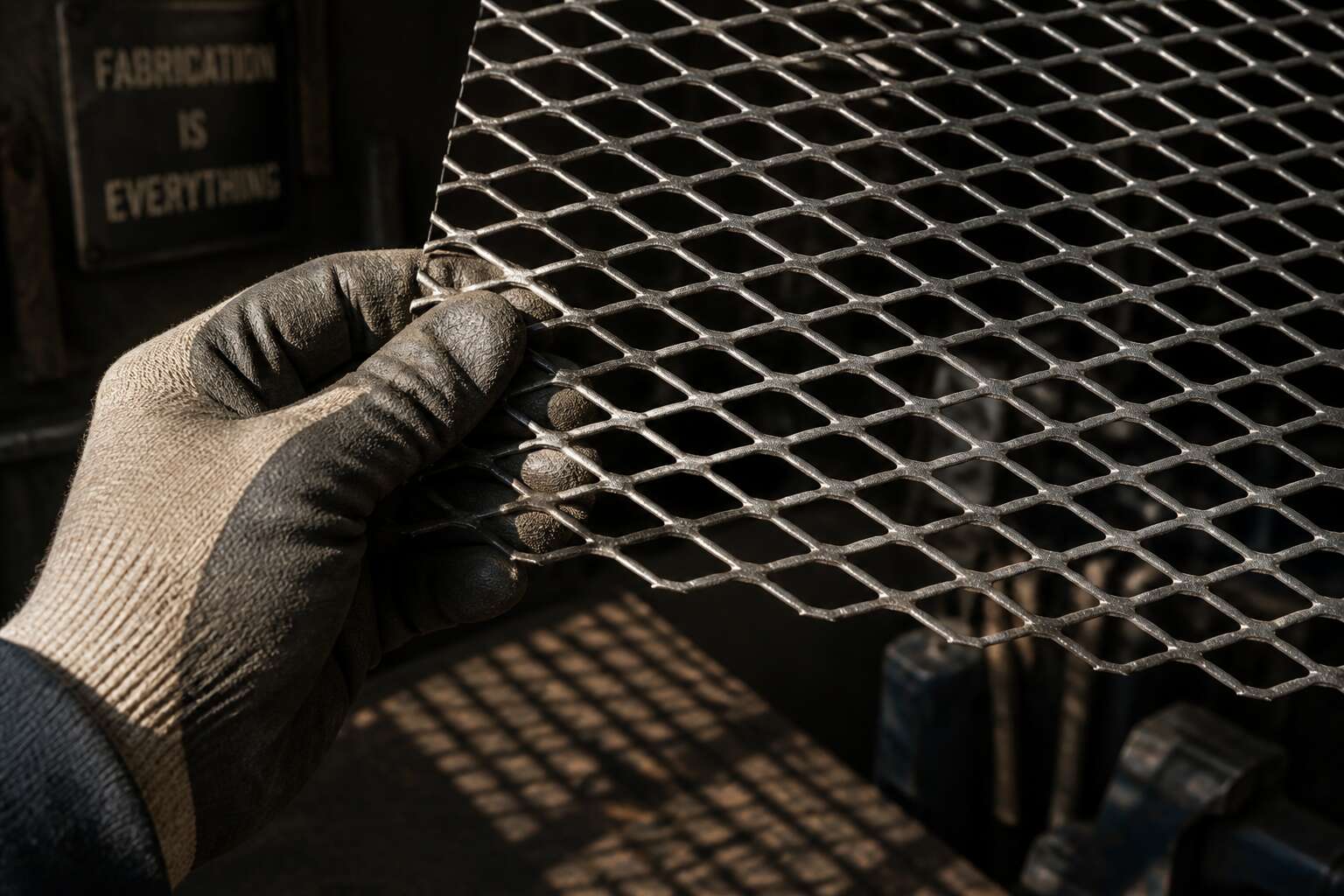
Metal wire cloth reveals its true nature in the half light of a Durban factory. It is a structure of tension and precision. The grade of stainless steel, the diameter of the wire, the exact pitch of the weave, each variable decides whether a fabrication net holds firm against coastal corrosion or fails silently under load.
Weaves matter as much as metal. Plain weaves serve simple filtration, while twilled weaves offer strength at fine apertures. For extreme pressure, a Dutch weave creates a dense gap that catches particles other patterns miss. Consider what each structure offers:
- Plain weave: balanced, cost effective, suited to general sifting.
- Twill weave: greater strength per micron, resistant to distortion.
- Dutch weave: wedge shaped pores for trapping fine solids.
The specifier must ask what the fabrication net must endure, not merely what it must sift.
Synthetic Polymers vs. Metallic Alloys
The choice between synthetic polymers and metallic alloys should unsettle any engineer. Polymer meshes resist chemical attack and weigh less, yet they creep under sustained heat. Alloys handle higher temperatures but succumb to pitting in coastal salt air. For a fabrication net, the operating environment dictates the material, not the other way around. I have watched project teams pick a mesh purely on price, then pay triple for replacements.
Consider how each behaves in situ:
- Polypropylene: excellent for acidic slurries, poor under UV exposure.
- Polyester: dimensionally stable, but vulnerable to hydrolysis.
- Stainless steel 316L: robust against chlorides, costly to maintain.
A fabrication net made from polymer may offer initial savings, but its service life in a Durban warehouse depends on humidity levels. Metallic alloys require careful electrical isolation to prevent galvanic corrosion. Understanding these trade-offs prevents expensive downtime. That is the real value of material literacy!
Mesh Opening Size and Wire Diameter Fundamentals
A fabrication net’s true character emerges from opening size and wire diameter. Opening size sets the boundary for particles, while wire diameter determines how much force the weave can withstand. In South African mesh applications, these two values demand scrutiny; a narrow opening paired with a fragile wire can collapse under load, and a robust wire reduces the flow path.
- Open area percentage, which controls flow rate
- Particle retention band, which determines what gets filtered
- Wire stiffness, which governs resistance to deformation
The interplay matters more than either value alone. A mesh with a nominal opening of 200 microns may behave differently once stretched onto a frame, or after exposure to sunlight. Tolerances stack, shifting effective performance. That is why an engineer must consider both dimensions together, not as separate specs. Understanding these fundamentals lets an engineer predict performance. A fabrication net rewards such scrutiny with longer service.
Corrosion Resistance and Surface Treatments
Rust does not negotiate. A fabrication net that ignores corrosion is merely a temporary arrangement, and in South Africa’s coastal or high-humidity zones, that arrangement can expire faster than a politician’s promise. Chlorides are the usual suspects, but even industrial atmospheres carry their own chemical grudges against wire mesh.
Surface treatments are where engineers get to fight back. Galvanising offers a zinc sacrifice, while passivation on stainless alloys encourages a thin, invisible shield. Some applications demand powder coating, others prefer anodising, and a few stubborn settings simply call for thicker wire as a survival tactic.
- Zinc galvanising for sacrificial protection
- Electropolishing to remove micro-imperfections
- PVDF coatings for aggressive chemical exposure
Each treatment alters the fabrication net’s interaction with its environment, shifting service life from a gamble into a calculation. Choose wisely, or let your mesh explain the consequences to your maintenance budget.
Critical Applications Across Manufacturing Sectors
Safety Barriers in Heavy Equipment Zones
One loose bolt from a conveyor can carry enough force to fracture a skull. In heavy equipment zones across South African plants, that risk shapes every safety decision. A fabrication net mounted between workers and rotating machinery provides a last line of defence.
Engineers choose mesh geometry based on impact velocity and load angle. A galvanised fabrication net holds up in humid coastal foundries, whereas a high carbon variant manages the abrasive dust of inland mineral processing. The barrier must flex without tearing, and anchor welds deserve monthly checks.
- Fixed frames for crusher and press perimeters
- Tensioned panels for temporary maintenance zones
One Mpumalanga coal plant saw shutdowns drop by a third after installing these nets. Containing a failed component on site lets crews secure the area quickly.
Filtration Systems for Liquid and Airborne Particles
In Durban’s chemical works, a single fabrication net straining suspended solids from process water can outlast three pumps. The mesh traps particles down to micron range, yet lets viscous fluids flow without cavitation. That durability matters when downtime costs more than the plant’s weekly output.
Airborne filtration demands different geometry. A fabrication net mounted above a grinding station catches metallic dust before it settles into workers’ lungs. These systems operate across cement plants, food processing lines, and even paint booths where overspray becomes a fire hazard.
- Textile mills use nets to filter lint from recirculated air
- Breweries strain yeast slurry through fine mesh panels
- Pharmaceutical plants separate active ingredients from solvent streams
Each sector tweaks the weave and tension to match its own contaminant profile. The result is a barrier that cleans without choking, whether the threat rides a liquid current or rides the wind itself.
Conveyor Belt Support and Separation Screens
A single conveyor jam stops an average South African mine for over two hours. The quiet fix is a fabrication net tensioned beneath the belt surface. It absorbs impact from heavy ore while letting fines sift through, so rollers keep spinning and belts last three times longer.
Beyond support, these nets work as separation screens. Crushed aggregate, recycled glass, and even grain get graded by aperture size. One plant manager told me he replaced a steel screen with a fabrication net and saw wear drop by half.
- Coal operations separate rock from clean fuel.
- Quarries sort gravel into distinct grades.
- Packaging lines screen out broken cashews.
Every sector tunes the weave tension and edge crimp to its own material. That precision turns a simple mesh into a dependable barrier against downtime.
Architectural Cladding and Decorative Panels
Architects rarely confess it, but wind scares them. A fabrication net, used as cladding and tensioned over a building’s facade, changes that. It deflects debris, shades glass, and lets the structure breathe.
Manufacturing sectors hold their own tensions. One factory uses a fabrication net to catch sparks from a cutting line. Another relies on it to stop stray components from ricocheting off machinery. That same mesh protects a worker on Monday and shapes a modern lobby by Friday!
Common applications:
- Elevator shaft enclosures that hide moving counterweights
- Decorative panels that mask acoustic insulation
- Partition screens that divide warehouse floors while passing light
The material’s geometry does the work. Aperture size controls airflow. Edge crimp controls rigidity. Tension controls everything else.
Aerospace and Automotive Component Curing
Composite curing in aerospace and automotive sectors has strict tolerances. A single void can scrap a wing spar or a drive shaft. A fabrication net manages the uneven pressure inside an autoclave. I have watched it work as a breather layer. It pulls air out of the laminate stack. It also prevents resin from pooling. The net’s open geometry distributes heat uniformly. Cycle times drop in automotive curing because the net allows faster temperature ramps. For aerospace, traceability improves because the net leaves a consistent surface finish. Consider what this fabrication net affects in practice:
- Air evacuation speed
- Resin flow uniformity
- Final part thickness tolerance
Engineers specify the correct aperture and wire diameter for each resin system. The wire diameter and mesh opening size determine how well the net performs under vacuum. I always tell engineers to test the net with their specific resin.
Selecting the Right Netting for Your Operations
Load-Bearing Capacity and Tensile Strength Requirements
The true test of a fabrication net emerges when the load is uneven and the tension is relentless. I have seen operations where supposedly heavy duty options gave way under cyclic stress. Load-bearing capacity is not a fixed number; it shifts with edge conditions, attachment points, and temperature. Tensile strength reveals the break point, but the working load limit reveals daily capability.
Specifying a fabrication net for your operation requires matching these tolerances to your actual environment.
- Determine the maximum dynamic load instead of relying on static weight
- Account for shock loading when materials drop or snag
- Multiply by a safety factor to absorb field variables
That approach prevents failures I have witnessed across South African plants. When the specification is wrong, the net fails fast, and the consequences travel beyond the immediate damage. Select for endurance rather than initial strength alone.
Environmental Exposure: UV, Chemicals, and Temperature
The Northern Cape sun exposes every weakness in a fabrication net. I have seen nets lose their elasticity within two summers when the polymer lacked sufficient UV stabilisers. Ultraviolet radiation attacks the molecular structure quietly, and the damage shows up later as surface cracks and fraying. Chemical exposure creates its own failure modes. Sulphuric acid fumes from battery plants or caustic washdown solutions can swell or dissolve certain synthetic fibres entirely.
Temperature cycling compounds these effects. A fabrication net that flexes at 35 degrees Celsius turns brittle at 4 degrees. The specification must account for the full range of site conditions rather than the average.
The Highveld brings intense ultraviolet radiation and sudden hailstorms. The Lowveld brings humidity and fungal growth. Site-specific assessment prevents costly replacements. Mining operations in Gauteng face ozone and sulphur compounds. Coastal operations in Durban face salt spray and humidity. Each environment demands a different formulation.
Custom Cutting, Rolling, and Finishing Options
A net that survives two months on the Highveld will not last two weeks on the coast if the edges are raw. Custom cutting, rolling, and finishing often get ignored until a site failure forces the question. The right fabrication net needs more than good mesh.
Reinforced edges matter. Raw cuts fray within weeks. Rolling options affect transport and installation. A tight roll reduces creases, but a loose roll prevents stress marks. Finishing touches, like welded seams or heat-sealed borders, protect the net where it takes the most punishment.
What separates a professional supplier from a box-mover:
- Heat-sealed edges that resist unravelling.
- Pre-drilled eyelets for quick rigging.
- Custom widths cut to your support structure.
A fabrication net is only as strong as its weakest edge. Get the finishing wrong, and you will buy a replacement sooner.
Installation Best Practices and Safety Standards
Proper Mounting Hardware and Tensioning Techniques
A single underrated bracket can turn a fabrication net into a liability on a busy mining floor near Rustenburg. Mounting hardware must distribute force evenly across the anchor zone, and PTFE washers prevent galvanic corrosion where steel meets aluminum frames. The fabrication net only endures when its edge binding is protected from sharp bracket edges.
Tensioning demands measured torque. We use a calibrated gauge to check deflection across each panel. Over-tensioning distorts the diamond weave and creates stress risers; under-tensioning leaves a sag that catches machinery. Site records show most failures trace back to loose clamps after thermal cycling, not material fatigue. Audit logs track three variables:
- Clamp torque drift after 500 hours of operation
- Edge binding wear along the contact line
- Frame squareness at each anchor point
Dynamic loads from conveyor vibration gradually loosen fittings, so the fabrication net behaves best when the frame and fabric act as one loaded system.
Seam Overlap and Joint Reinforcement Methods
Sixty percent of fabrication net failures begin where panels meet, not in the open weave. Overlap width should match the mesh’s diamond pitch, and every joint needs a secondary reinforcement strip. In South African high-traffic installations, we double stitch hemmed edges with polyester cord. Safety standards from SANS 10310 demand that seam load ratings equal the base fabric. For visibility, use contrast threading on reinforced joints. A quick audit checklist:
- Check overlap alignment under tension
- Verify stitching density per metre
- Confirm reinforcement patch coverage
Remember, a loose joint isn’t a minor issue. It’s a gap in the safety barrier. We test samples by pulling them to 1.5 times the rated load, and that’s where good seam work separates from guesswork. The best fabrication net in the world fails at a bad seam.
Workplace Safety Compliance and OSHA Guidelines
According to the South African Department of Employment and Labour, over 200 workplace injuries each year involve falling objects. A correctly installed fabrication net changes that number. In my years auditing sites, I have seen one missed anchor point compromise an entire barrier.
Workplace safety compliance demands more than hanging mesh. Every installation must align with SANS 10310 and OSHA guidelines for load testing and edge protection. The ground condition, the anchor spacing, and the net’s tension all affect performance.
1. Verify anchor points against the engineering drawing.
2. Confirm the fabrication net’s rated load matches the application.
3. Document each inspection with dated photographs.
Without these steps, a barrier fails. OSHA guidelines exist because human error repeats itself. We install with that truth in mind!
Inspection Routines for Damage and Wear
An anchor point that shifts a single centimetre can turn a fabrication net from a safeguard into a hazard. I have seen it on site. The tension slackens, the load path changes, and the barrier no longer meets the rated strength. Installation best practices demand that every edge be pulled taut and every connector inspected before the first shift begins.
Safety standards do not stop at the handover. Weekly inspections catch the wear that accumulates quietly: abraded strands, corroded clamps, or a mesh that has started to sag. Use a documented routine.
- Check each anchor for movement or rust.
- Measure sag against the original tension tolerance.
- Look for broken filaments along the load-bearing axis.
Replace damaged sections immediately. A fabrication net with a compromised zone fails faster than a complete tear. Log every finding with dated photos. That record becomes your proof of due diligence.
Tool Selection for Precise Trimming
Precision trimming begins with the right tool. A fabrication net can be compromised by a jagged cut, so I rely on hot knives for polymer meshes and tungsten carbide shears for metallic alloys. Safety standards extend beyond the net itself; they include the workspace around it. Keep the cutting area free of debris and ensure every edge is square before tensioning.
A clean trim reduces the risk of load path deviation and early wear. In practice, I follow a simple sequence:
- Measure twice against the specified dimensions.
- Mark the cut line with a chalk reel.
- Cut slowly and steadily, without forcing the blade.
- Inspect the exposed filaments for any fraying.
The goal is not speed. It is consistency. When each edge matches the specification, the fabrication net performs exactly as engineered. That is the quiet art of installation!
Storage Protocols to Prevent Deformation
A fabrication net stored badly will not lie flat on installation day. Deformation is permanent, a curl or crease that tension cannot fix. In South Africa’s shifting heat and humidity, storage protocol matters as much as the material itself.
Keep rolls horizontal on a clean, dry surface. Never lean them against a wall. Weight must stay even across the roll, and packaging should breathe without exposing the mesh to direct sun.
Follow these storage rules:
- Store rolls on a flat pallet, never on their ends.
- Keep the area below 30 degrees Celsius.
- Inspect the packaging before installation day.
Before installation, unroll the fabrication net and let it settle for a few hours. I have seen tensioning fail simply because the mesh was rushed. Keep the workspace clear and give yourself room to move. A calm site produces a true installation every time.
Maintenance, Longevity, and Cost Efficiency
Cleaning Methods That Prolong Material Life
A fabrication net rarely fails from dramatic impact. It succumbs to accumulated grime that abrades filaments over time. For South African operations, routine cleaning is the most cost effective way to prolong material life.
Wash with low pressure water and a soft nylon brush. Avoid aggressive solvents. My experience shows that warm soapy water beats chemical degreasers every time. Follow these steps:
- Use a mild pH neutral detergent
- Rinse thoroughly to prevent residue
- Dry naturally before reinstalling
This method preserves tensile integrity and costs only a few Rand per cycle.
Identifying Signs of Fatigue and Micro-Fractures
A fabrication net does not announce its own undoing. The fatigue that claims it is a quiet, incremental erosion, a slow unmaking of the tensile structure itself. In my years inspecting these materials across South African industrial sites, I have learned that the most dangerous damage is rarely the dramatic tear. It is the subtle micro-fracture, the hairline flaw you must hunt for with a disciplined eye.
The first place to look is at the intersections where filaments cross. Under load, these nodes bear the brunt of the stress. Examine the diamond-shaped apertures closely for any distortion in their geometry. A net that was once perfectly square will begin to lean, its angles becoming acute or obtuse. This deformation is a whisper of the material yielding. Left unchecked, these stress points become the genesis of a catastrophic structural failure, costing far more in downtime than a simple replacement ever would.
Beyond the distortion, you must feel for the damage your eyes cannot see. A routine physical inspection should include a tactile sweep of the surface. The goal is to identify the presence of tiny, brittle fractures that feel like a rough patch on an otherwise smooth wire. These micro-fractures are the beginning of the end. They indicate that the metal has lost its ductility and has become brittle.
– Check for any loss of tension along the perimeter anchor points.
– Look for discolouration or rust spotting that signals chemical attack.
– Listen for an unusual creaking sound when the net is loaded, a sign of filaments rubbing against each other.
Proactive monitoring of these fatigue signs is a component of operational longevity. The cost of a thorough inspection is a fraction of the price of an emergency replacement and the associated halt in production. In a harsh environment like the South African highveld, where dust and temperature fluctuations are constant adversaries, these quiet failures accelerate. The data is clear: a routine that anticipates this decay is your most reliable safeguard.
Recycling and End-of-Life Disposal Options
A fabrication net that outlives its purpose is not waste; it is a resource. Regular maintenance, when timed to real wear patterns, stretches the usable life far beyond the manufacturer’s baseline. This is not about polishing metal for appearances. It is about preserving tensile integrity until the very last productive shift. Longevity, in this context, is a financial calculation.
When the net finally reaches its end, recycling recovers the alloy value. South African scrap markets accept stainless and galvanized meshes, though contamination with polymers complicates the process. Sort your waste streams before disposal.
- Separate mixed material nets from pure alloy ones.
- Confirm the scrap yard’s tolerance for residual coatings.
- Document the weight for accurate credits.
Cost efficiency closes the loop. A fabrication net that is maintained well, then recycled properly, returns a portion of its original investment. That is the quiet economics of a tired mesh.
Cost-Benefit Analysis of Premium vs. Standard Grades
Premium fabrication net costs roughly 40% more upfront, yet field data from local mining operations shows it survives 2.3 times longer under abrasive conditions. That calculation should drive every budget review!
Standard grades demand more frequent inspections and earlier replacement. Premium alloys tolerate minor wear without losing tensile integrity, so your crew spends less time patching and more time producing. Longevity reduces your total cost per square meter.
Consider the full ownership cycle:
- Standard fabrication net: lower purchase price, higher lifecycle cost.
- Premium grade: higher initial outlay, lower downtime and disposal frequency.
- Maintenance labour: the hidden variable that often exceeds material costs.
When we compare cost efficiency, include the price of a mid-shift failure. A standard net that snaps forces overtime and urgent freight charges. Premium grade’s predictable performance keeps those charges from appearing on your invoice.


0 Comments