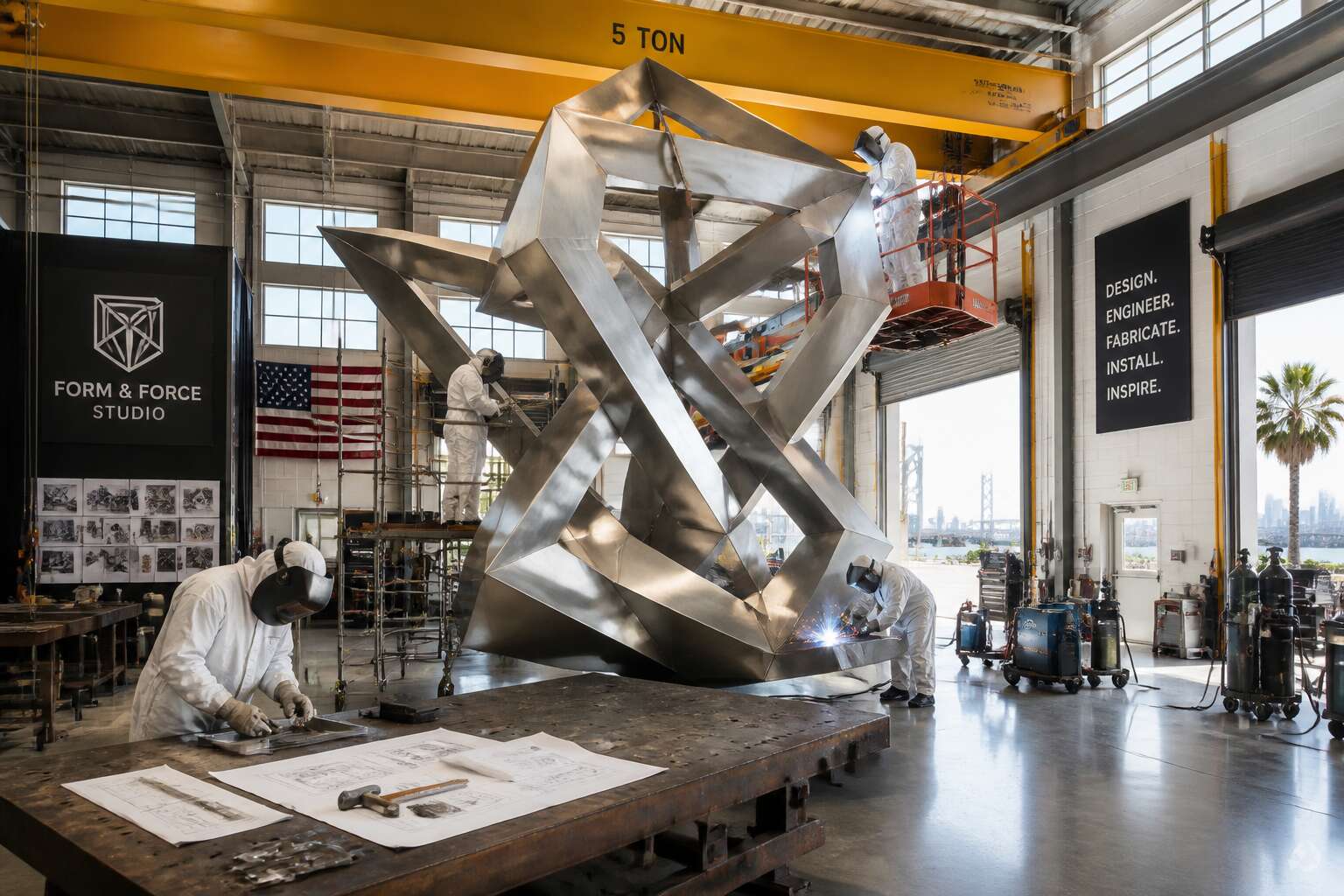
The Bay Area’s Unique Creative Fabrication Ecosystem
From Silicon Valley Tech to Hands-On Artistry
When I step into a Bay Area workshop, I see laser cutters humming beside ancient welding rigs. This is the art fabrication bay area ecosystem at work. Programmers trade code snippets with sculptors over espresso, and a robotics engineer spends weekends bending steel for a public plaza installation.
The creative energy in the art fabrication bay area flows in both directions:
- Tech startups open their rapid prototyping labs to local artists.
- Industrial warehouses transform into shared studios for large scale sculpture.
- Universities pair engineering students with seasoned fine art mentors.
This collision of disciplines yields work that resists simple labels. It is functional, expressive, and anchored to the region’s peculiar character. For makers, this corner of California offers rare access to advanced machinery alongside a community that still treasures the human hand behind the machine!
Key Hubs: San Francisco, Oakland, and Beyond
In San Francisco’s Dogpatch, a sculptor and a startup founder share the coffee cart, though only one knows the difference between mild steel and stainless. The art fabrication bay area scene lives inside century-old brick warehouses, where workshop floors sit beneath exposed timber. Steep rents push many makers toward Oakland, where cinder-block buildings along the estuary suit a different budget.
Oakland offers space and tolerance. A fabricator in West Oakland can run a plasma table late into the night without a neighbour’s complaint. The city’s textile and blacksmith communities often share the same loading docks.
Richmond and Vallejo attract studios that demand high ceilings and open work yards. Each hub carries its own temperament:
- San Francisco prioritises deadlines and architect meetings.
- Oakland welcomes larger commissions and salvaged material.
- Richmond and beyond handle monumental steel with easy shipping access.
Choosing a yard in the art fabrication bay area comes down to your appetite for an audience or an acre.
Why Artists Flock to This Region
There is a particular silence in a Bay Area workshop after midnight. Fog rolls through open bay doors and settles on steel plate. The salt air does not ask permission. It oxidizes, patinas, claims. Artists come for the climate’s severity, not its mildness. The same weather that rusts iron demands preservation skills. The art fabrication bay area has no single aesthetic. An accumulation of shipyard ghosts, aerospace precision, and migrant craft traditions, crushed into industrial zones where rent still allows failure.
What binds the art fabrication bay area is a tolerance for process. A foundry in Alameda pours bronze at dawn. A neon bender in Berkeley tests tubes against a grey sky. The ecosystem rewards the obsessive.
You can weld at midnight without apology, find a material vendor who speaks your language, let the fog hide your mistakes until morning. The city forgets you. You finish what you started.
The Influence of Local Art Schools and Residencies
San Francisco Art Institute’s legacy courses dispersed into Oakland studios after the school closed in 2022. A generation learned to treat the welding torch and the code compiler as equal tools. California College of the Arts runs a sculpture program where students spec marine-grade aluminum. Stanford’s Product Design program turns out graduates who can machine their own steel.
Residencies amplify this. Headlands Center for the Arts in Marin offers long stretches of studio time in the hills. Recology’s artist residency gives access to a dump’s sorting floor, and the materials arrive in bins. I once watched a painter learn to weld at The Crucible because her project demanded a steel armature.
- The Crucible in Oakland opens its workshops to newcomers, from blacksmithing to neon bending
- The Berkeley Art Studio rents kilns on a sliding scale to the wider public
This art fabrication bay area runs on mutual dependence. Schools furnish method. Residencies furnish means.
Core Services Offered by Professional Fabrication Studios
Large-Scale Sculpture and Installation Support
A single monumental sculpture can require more engineering hours than a small office building. In the art fabrication bay area, professional studios deliver large-scale sculpture and installation support, managing everything from initial design consultation to final crane lift.
These studios provide technical expertise that turns fragile maquettes into durable public works. Core services often include:
- Structural engineering and load testing
- CNC machining and robotic welding
- Transport logistics and crane operation
- Site preparation and seismic anchoring
For installation, crews handle permitting, foundation prep, and alignment. A dedicated project manager coordinates with architects and electricians, so the artist remains free to focus on aesthetic decisions.
Digital Modeling and Prototyping
In the art fabrication bay area, professional studios use digital modeling to turn a maquette into an engineered object. They scan, mesh, and apply finite element analysis to predict real world behavior. Virtual reality lets an artist walk around their piece before it exists physically.
Prototyping via 3D printing catches flaws early. One studio found a stress fracture that would have appeared during casting. That saved months of work.
- Laser scanning to capture existing site geometry
- Parametric modeling for quick adjustments
- Subscale prints for client approval
Digital prototyping is neither glamorous nor cheap, but it beats discovering an error during a crane lift. The Bay Area’s fabrication shops have learned this through painful experience.
Surface Finishing, Painting, and Coating
In the art fabrication bay area, surface finishing shapes the final appearance of a sculpture. Tone and presence depend on patina, powder coat, or a polished edge. Studios offer treatments ranging from anodizing to automotive-grade paint.
I have watched technicians apply a translucent coating that protected bronze from coastal fog while preserving its surface. The process demands patience! Each layer cures under controlled humidity, and a single misstep alters the final tone.
- Sandblasting and abrasive texturing
- Electrostatic painting for even coverage
- Custom patinas using chemical washes
Painting requires a cleanroom environment. Dust particles ruin any gloss finish. Professional shops maintain booths with positive air pressure, ensuring nothing settles on the surface before curing completes.
Structural Engineering and Load Calculations
Behind every monumental sculpture stands an invisible skeleton of steel, aluminum, and precise mathematics. A piece that appears effortless in a gallery required rigorous structural engineering to survive wind loads, seismic activity, and the relentless weight of its own mass. In the art fabrication bay area, engineers collaborate directly with fabricators to transform artistic vision into physically sound reality. This partnership often begins with load calculations that determine material thickness, weld specifications, and support placement, all before the first torch touches metal.
Finite element analysis software now allows studios to simulate stress points on complex geometries, identifying potential failure zones that would be invisible to the naked eye. Fabricators use these simulations to reinforce hidden areas without compromising the aesthetic surface. One studio I visited calculated the exact flex of a cantilevered installation over three different temperature ranges, ensuring the piece would remain stable whether baked in summer sun or chilled by fog. The margin for error is razor thin; a miscalculated bearing point can shift the entire center of gravity, turning a gallery centerpiece into a hazard.
- Finite element analysis for stress point identification and material optimization
- Seismic bracing and mounting systems designed for earthquakes
- Weight distribution calculations for crane lifts and permanent installation
Clients often overlook this engineering backbone, assuming a foundry simply welds and ships. However, the most respected fabrication houses treat structural integrity as a core design service, offering revisions alongside aesthetic critiques. This technical rigor ensures that when a bronze monument rises in a public plaza, it remains anchored for generations. Without these calculations, the art fabrication bay area would lose its reputation for producing works that endure both artistic scrutiny and environmental punishment.
Selecting the Right Fabrication Partner for Your Project
Evaluating Portfolios and Past Projects
Selecting the right art fabrication bay area partner can make or break a project. A recent survey of public art administrators found that 78% of project delays stem from fabrication issues rather than design flaws. This statistic highlights a crucial reality. The choice of who builds your work deserves as much attention as the work itself. Portfolios tell a story, but only the full narrative reveals the craft. When evaluating past projects, look beyond the final photographs. Ask about the processes used and the challenges faced during fabrication. A team that overcomes obstacles demonstrates resilience. One that avoids them entirely might lack experience. Consider how their previous work aligns with your specific needs. The Bay Area produces a distinct aesthetic. Local fabricators understand this context. They know how to integrate their work with the region’s architectural language. This local knowledge proves invaluable. For example, examine how a fabricator handles:
– Weld quality on visible seams
– Surface preparation under the finish
– Precision of drilled holes and bolt patterns
– How they manage load-bearing requirements
These details reveal the difference between a maker and a true fabrication partner. The fabrication bay area ecosystem thrives on collaboration. A partner who communicates clearly during the bidding process will likely communicate well during production. Trust your instincts, but verify them with evidence. The best relationships start with transparency about capabilities and limitations. A professional team will show you both their successes and their learning experiences. The right art fabrication bay area partner treats your project as their own. They sweat the small stuff so you do not have to. This level of engagement transforms a simple build into a seamless extension of your creative vision.
Assessing Capabilities and Specializations
Selecting the right fabrication partner requires looking beneath the surface of their showreel. The art fabrication bay area is dense with skilled shops, but capabilities vary sharply. I have seen stunning sculptures fail because the team lacked specialized welding or large-scale machining. Do not assume a generalist can handle your project.
Probe their specific expertise. Ask about equipment like waterjets or CNC routers. Inquire about their experience with dissimilar metals or heavy-gauge steel. A partner who admits limitations is worth more than one who promises everything! Consider these capabilities:
- Precision machining for complex geometries
- In-house finishing for quality control
- Structural engineering support for load-heavy works
That last point often decides success. The right partner will align their strengths with your project’s real demands, not the other way around.
Budgeting, Timelines, and Transparency
In the art fabrication bay area, budget and timeline are their own artistic media. A construction budget is a fragile thing, and a calendar is a promise. Without absolute transparency, both fracture.
Demand a detailed quotation that itemizes materials, labor, and contingency. Look for the shop that tracks hours rigorously and communicates delays before they become crises. This is how trust is built.
A good partner will maintain a production schedule that functions as a shared map. They should be able to articulate a clear workflow, with specific milestones for your approval. And there are certain things they should always volunteer, such as:
– The cost of revisions and change orders.
– The lead time for ordering specific materials or components.
– Their policy on overtime and rush fees.
– The exact payment schedule and any deposit requirements.
This level of candor is rare. Seek out the vendor who clarifies the murky corners of the process, and your project will retain its magic, arriving complete and on time.
The Collaboration Process: From Concept to Completion
A portfolio shows finished work; process reveals character. Choosing a partner in the art fabrication bay area demands attention to how a shop thinks. Ask how they handle ambiguity! Observe whether they ask about your installation environment before quoting. The right shop treats your confusion as useful information.
The workflow from concept to completion follows a clear sequence. A strong partner moves from feasibility sketches to material samples, then to a full prototype. Each step produces something you can hold. Some shops send daily photo updates; others schedule weekly reviews. Consistency matters more than the update format.
- Ask how they handle unexpected material failures.
- Request examples of design changes made mid project.
- Check whether they offer structural feedback early.
In the art fabrication bay area, the right relationship makes a daunting build a shared investigation. Your vision persists because the process values curiosity over compliance.
Red Flags to Watch Out For
A partner who answers every question too quickly might not be listening. In the art fabrication bay area, red flags appear in the first conversation. Does the shop ask about your installation site? Do they request your structural drawings before quoting? A reliable shop treats your confusion as useful information. They should name risks in your design and offer alternatives.
Watch for vague responses about past failures. A shop that cannot describe how they handled a broken weld or a delaminated finish lacks transparency. They should show you samples and test results without prompting. If they avoid prototypes or rush you to sign, walk away.
- No questions about environment or access.
- No examples of design changes.
- No mention of load calculations.
The right partner in art fabrication bay area will treat the build as a shared investigation, not a transaction. They value curiosity over compliance, and that shows in every update.
Emerging Trends and Technologies in Creative Fabrication
Sustainability and Eco-Friendly Materials
Every year, art fabricators in the region discard tons of material offcuts. A 2023 survey by a local sustainability coalition found that 40% of fabrication waste could be compostable or recyclable. That number is shifting as the art fabrication bay area embraces circular design. Many studios now use bio-based resins for large-scale sculpture, replacing toxic fiberglass with materials made from algae and fungal mycelium. These options perform equally well without the hazardous footprint.
Metal shops are turning to post-consumer aluminum, which requires 95% less energy to process. Some foundries have switched to solar-powered furnaces and reclaimed bronze. The shift is practical, not idealistic. Consider a typical public artwork commission:
– Recycled steel armatures with high post-consumer content
– Bioplastic filaments for internal lattice structures
– Reclaimed wood cladding from demolished Bay Area piers
These choices lower material costs and appeal to climate-conscious clients. The art fabrication bay area is moving toward a culture that treats waste as a design flaw.
Integrating Electronics and Interactive Elements
Interactive fabrication now accounts for a third of commissions across the art fabrication bay area. Clients want pieces that react to touch, sound, or movement. Studios responded by merging metalwork with embedded systems. One Oakland shop pressed capacitive sensors into cast bronze, turning a bench into a sound instrument.
Consider the components behind such work:
- Microcontrollers rated for outdoor exposure
- Low voltage LED strips with custom lenses
- Pressure sensors hidden under composite decking
- Wireless transmitters for real time adjustment
The art fabrication bay area benefits from nearby semiconductor distributors and prototyping labs. Fabricators build test rigs to simulate sunlight, rain, and vibration. They seal electronics with marine grade epoxy. I saw one project on Market Street use algae based bioplastic panels that glowed when joggers passed. The integration demands patience, and that patience pays off!
The Rise of CNC Routing and 3D Printing
CNC routing and 3D printing now shape nearly every major commission in the art fabrication bay area. These tools are not novelties; they are the backbone of modern production. We see a clear divide in how studios deploy them, yet both methods deliver precision that was once impossible.
CNC routing excels with subtractive work. It carves solid materials like oak, walnut, and aluminium. The art fabrication bay area relies on large format routers for sculptural bases, architectural panels, and moulds. The machines run for hours, translating digital models into physical forms without losing accuracy. For artists, this means repeatable cuts across a full series of pieces. One workshop recently milled a complex wave pattern into a redwood bench, the grain aligning perfectly with the digital plan.
3D printing adds a different layer of possibility. Additive manufacturing creates internal lattices and hollow structures that traditional methods cannot produce. Studios in the region use industrial printers for prototyping and final parts. A local fabricator produced a full scale maquette for a public fountain, printed in segments, then assembled and coated to mimic bronze. That same model now guides the casting process.
– CNC routers handle large sheets of plywood, foam, and metal
– 3D printers create intricate details and hidden channels
– Both tools reduce material waste during the design phase
– Digital files allow instant revisions before any cutting starts
The art fabrication bay area benefits from this convergence. Workshops no longer choose between handmade and machine made. They blend the two. A welded steel frame may receive a 3D printed joint, while a carved stone base uses a CNC routed template for its final profile. The result is work that feels crafted and engineered at once.
These technologies also change how we quote and plan projects. We can simulate a build before touching a single sheet of material. Clients see a digital preview, we adjust the design, and the fabrication process begins with confidence. That speed and flexibility keeps the region competitive.
Collaborative Design and Virtual Prototyping
Collaborative design tools have become the new workshop floor for the art fabrication bay area. I have watched teams across San Francisco and Oakland iterate on spatial layouts using real-time point clouds and augmented reality overlays. Virtual prototyping now lets us stress-test a cantilevered bronze structure or a kinetic facade before any material is cut. One studio I visited adjusted a sculptural stairway’s entire load path during a client call, all through shared cloud models.
The shift is tangible:
– Live multiuser sessions replace static PDF drawings.
– Photogrammetry scans feed directly into fabrication files.
– Version history eliminates the old confusion of email chains.
These workflows reduce risk dramatically. We now catch clearance errors and assembly conflicts weeks earlier. For a region known for precision, that speed is not a luxury; it is the baseline.
Adaptive Reuse of Found Materials
Seventy percent of new public art commissions now start in scrapyards, not studios. The art fabrication bay area has embraced adaptive reuse with a vengeance, yet the results feel precise, not improvised. I have watched fabricators transform derelict ship chains into load-bearing lattices and obsolete circuit boards into tessellated cladding. This is not recycling; it is a new material grammar.
Consider the techniques now common:
– Salvaged steel is heat-straightened and carbon-dated.
– Reclaimed redwood is CNC-scanned and laminated.
– Found glass is crushed and sintered into structural panels.
These methods deliver authenticity that virgin materials cannot. The art fabrication bay area now treats decay as a design resource. For clients in Johannesburg or Cape Town, this offers a compelling alternative to imported fabrication. Locally sourced history, engineered for permanence.
Logistical Considerations for Large-Scale Art Projects
Permitting and Code Compliance in the Bay Area
A large-scale sculpture bound for a public plaza must satisfy municipal requirements before fabrication can begin. The Bay Area’s fragmented governance means a project approved in Oakland may face wholly different documentation in San Francisco or San Jose. Planning commissions weigh sight lines, public access, and environmental impact. Building departments scrutinize foundations and anchoring systems under local codes.
In my experience, an art fabrication bay area shop that ignores early permitting often pays for it later. The typical approval sequence includes:
- Encroachment permits for sidewalk or street placement
- Electrical permits for integrated lighting
- Public art commission reviews
- Seismic compliance documentation for elevated structures
A misplaced assumption about zoning can halt production immediately. Expeditors who know each city’s quirks save real time.
Transportation and Rigging for Oversized Work
Transporting an oversized artwork is where many projects stall. The art fabrication bay area shops I work with plan rigging routes the same way they plan welding sequences. They measure doorways, test floor load ratings, and simulate crane angles before a single bolt is tightened. That preparation matters because a public sculpture destined for downtown Oakland might enter the site through a loading bay that barely clears its base plate.
A typical move involves several coordinated steps:
– Route survey with a certified rigger.
– Overnight street closure permits and police escorts.
– Specialized air-ride trailers to protect fragile surfaces.
– Cranes rated for at least twice the piece’s weight.
Each decision changes cost and timeline. A mistake in weight distribution can crack concrete slabs or require a second crane rental. Getting this right keeps the project moving and protects the work itself.
Site Preparation and Installation Best Practices
Site preparation is where the unseen work happens. The art fabrication bay area crews I follow document every inch of the floor, check for uneven slabs, and measure ceiling heights twice. One team discovered a hidden sprinkler pipe that would have intersected a suspended sculpture’s path. That find saved a week of rework.
A reliable installation plan accounts for:
– Load-bearing capacity of the floor and roof attachment points.
– Environmental controls for temperature and humidity sensitive materials.
– Access pathways for equipment and personnel.
– Emergency shutdown procedures for integrated electronics.
Installation best practices demand patience. Crews set anchor bolts with epoxy and torque them to exact specifications. They use laser levels to verify alignment every few feet. The ground shifts, materials expand, and a piece that looked level in the studio tilts by a quarter inch on site. Good teams expect those variables and build adjustment time into the schedule. The result is a sculpture that stands as straight as the day it was welded.
Maintaining and Restoring Fabricated Pieces
Logistics do not end when the last bolt tightens. For art fabrication bay area studios, the true challenge arrives years later, when a piece needs restoration. I have watched welded steel develop hairline cracks from seismic sway, and delicate pigments fade under harsh gallery lights. Maintaining large-scale work demands a clear record of materials and finishes. A simple checklist prevents costly surprises!
- Document original welds and coatings.
- Schedule annual inspections for corrosion or loose joints.
- Keep spare fasteners and touch-up paint on hand.
Restoration requires planning. You might need a crane just to reach a damaged section. That is why designing for future maintenance matters as much as the initial build. The crews who thrive build with service in mind.

0 Comments